What should I know about remote discovery, video tours, and shortlist verification in New York, NY?
Buying an NYC apartment from afar works, but three things separate a smooth remote purchase from a costly one: knowing when a live video tour legally…
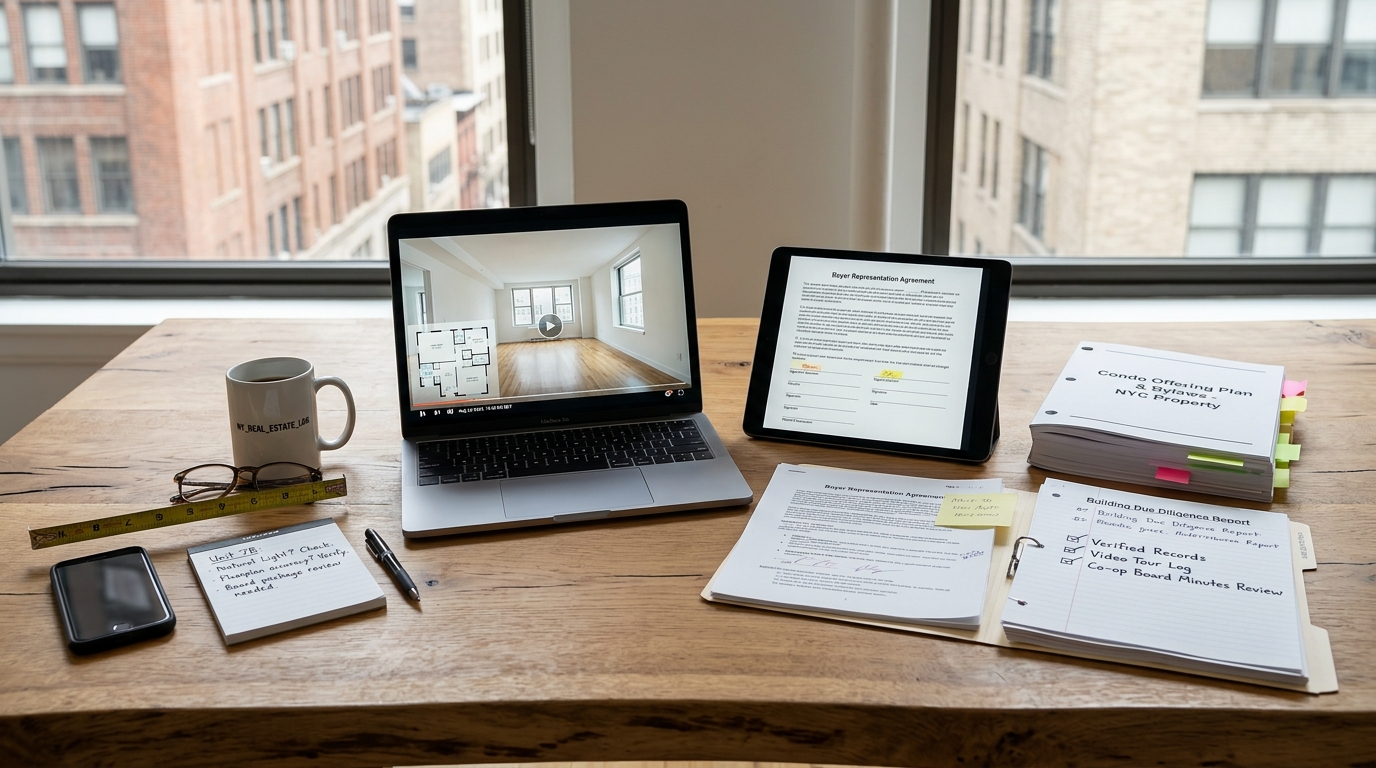
Buying an NYC apartment from afar works, but three things separate a smooth remote purchase from a costly one: knowing when a live video tour legally requires a signed buyer agreement, treating agent-guided tours as evidence while treating marketing reels as advertising, and verifying the building's paper trail before you wire a cent. Under the practice change that took effect August 17, 2024, a live virtual tour given by your agent triggers a written buyer agreement, while a listing broker's marketing video does not (NAR, Written Buyer Agreements 101). For most Manhattan apartments, which are co-ops and condos, you cannot lean on a seller's property condition disclosure, so your due diligence shifts to building financials and offering plans. And the single biggest financial risk in a remote deal is not the layout you can't see in person. It is wire fraud at closing, where emailed instructions get intercepted and your down payment vanishes.
Does a live virtual tour commit me to a written buyer agreement in New York?
Yes, if the tour is guided live by an agent working with you. Since August 17, 2024, an MLS participant working with a buyer must enter into a written agreement before touring a home, and the rule explicitly counts the situation where a broker visits the property and provides a video tour for buyers who may not be local (NCREC Bulletins). A buyer in London or Los Angeles shopping a Tribeca loft is exactly the scenario the rule was written for.
That agreement must state, specifically and conspicuously, the amount or rate of compensation your agent will receive or how it will be determined (NAR). Read that clause before you sign, because it defines what you owe and under what conditions.
Separately, New York law requires any licensee acting as an agent to disclose the nature of the agency relationship at first substantive contact. So a remote buyer in West Chelsea or Cobble Hill should expect two documents early: the agency disclosure form and the written buyer agreement. Neither is a formality. Both define who is working for whom before the first live walkthrough of a Flatiron one-bedroom happens over video.
What can a video tour hide about an NYC apartment's layout or condition?
A video tour can distort scale, hide defects, and misrepresent how rooms connect, which is why the source of the video matters as much as its content. A listing broker's marketing video is advertising. It is edited, lit, and often shot with a wide lens that makes a 600-square-foot Greenwich Village studio read as airy. Viewing it commits you to nothing and proves nothing about actual dimensions.
A live, agent-guided tour is closer to evidence because you can direct it. Ask the agent to pace the room heel to toe, open every closet, run the taps, pan slowly across ceilings for water stains, and hold the camera steady in corners where a wide lens would otherwise stretch the space. In a prewar Upper West Side unit, ask to see the window frames and the condition of the plaster. In a West Village walk-up, ask how many stairs and film the full climb.
Pending New York legislation would make this explicit by barring a virtual tour that materially misrepresents the layout, dimensions, or spatial relationships of a property. Those bills, S9584 and A11403, were introduced in 2026 and remain pending, not enacted, so their virtual-tour standard is not yet binding. Until it is, protect yourself by controlling the tour rather than trusting the reel.
What documents should a remote buyer request instead of a walkthrough?
The paper trail replaces the walkthrough, and for most NYC apartments it matters more than the tour because you cannot rely on a seller disclosure. As of March 20, 2024, New York sellers of one-to-four-residential homes must provide a completed property condition disclosure before signing a contract, and the 2024 amendment expanded that form from 49 to 56 questions. But the requirement does not apply to co-ops, condos, or HOA property not held in fee simple, which describes the overwhelming majority of Manhattan and Brooklyn apartments. A remote buyer eyeing a Park Slope co-op or a Battery Park City condo gets no PCDS at all.
So request the building's documents instead:
- The offering plan and any amendments, which describe the building's legal structure, unit dimensions, and common charges.
- Two years of board or condo association financial statements and the most recent budget, so you can see reserves and any planned assessments.
- Recent board meeting minutes, which surface disputes, leaks, facade work, and pending Local Law 11 repairs before they surface in your wallet.
- For a co-op, the sublet policy and the flip tax, both of which affect resale.
- A current title report and, for condos, the most recent common-charge and tax statements.
Have your attorney read the offering plan and the minutes closely. A cracked ceiling shows up on video. A $4 million facade assessment voted in last quarter only shows up in the minutes.
How much longer should a remote co-op purchase take than a condo?
Budget far more calendar time for a co-op, because the co-op board interview is usually an in-person requirement that a fully remote buyer cannot skip. A condo purchase is a document-based review that ends in the board either waiving or exercising its right of first refusal. A co-op purchase adds a full financial and personal review, a board package, and a subjective approval or denial. Well-priced Manhattan condos often close within 30 to 45 days of an accepted offer on a cash purchase, while NYC co-ops average 90 to 120 days because of that board process.
The structure also affects price and financing. Co-ops trade at a 15 to 30 percent discount versus comparable condos in the same neighborhood, largely because of board approval, subletting limits, and financing constraints. A remote buyer weighing a Carroll Gardens co-op against a Dumbo condo should confirm early that any lender actually writes co-op loans, since the bank must also review the building's financials.
| Dimension | Condo (remote-friendly) | Co-op (remote-constrained) |
|---|---|---|
| Board review | Document review, right-of-refusal waiver | Full financial review plus in-person interview |
| Time to close | About 30 to 45 days, cash purchase | About 90 to 120 days |
| Price effect | Baseline | 15 to 30 percent discount vs. comparable condo |
| New NYC deadline law | Not subject to it | Applies to co-ops with 10+ residential units |
One recent change narrows the gap slightly. A New York City law setting application-review deadlines for cooperative corporations with 10 or more residential units takes effect on or about July 28, 2026, and condominiums are not subject to it. It puts a clock on part of the co-op timeline, but it does not remove the in-person interview. If you are comparing structures, the tradeoffs in how NYC co-ops and condos compare and the detail in this Manhattan co-op and condo decision guide are worth reading before you commit.
How do remote buyers protect their money from wire fraud at closing?
Verify every wire instruction by phone using a number you already have, never a number from the email, because payment diversion is the dominant financial risk in a remote transaction. In one case reported to the FBI's Internet Crime Complaint Center, a buyer trying to close received a compromised email from what looked like the title company, with instructions to wire more than $1.3 million to a fraudulent account (FBI IC3 2025 Annual Report). Business email compromise caused close to $2.8 billion in reported losses in 2024, and total IC3-reported losses reached $16.6 billion that year.
Concrete steps that work for a Meatpacking District closing or a Financial District one alike:
- Call your attorney and the title company at a verified number to confirm wire details, and re-confirm if anything about the instructions changes, even by one digit.
- Treat any last-minute change to routing or account numbers as fraud until proven otherwise.
- Ask your bank to confirm the receiving account name matches the title company before releasing funds.
If a transfer does go wrong, speed is everything. The FBI advises contacting your bank immediately to request a recall of the funds and any indemnification documents (FBI IC3 PSA); the agency's Recovery Asset Team reported a 66 percent success rate freezing fraudulent transfers when victims act fast.
Remote online notarization is legal in New York, but it is conditional. New York notaries have been able to apply to perform remote online notarization since January 31, 2023, yet documents in a real estate transaction must be approved in advance by the lender, title agency, court, or attorney facilitating the deal. Confirm remote notarization is acceptable to every party early, so it does not become a closing-day surprise on your Sutton Place condo.
Let’s talk about your block, building, apartment
The right starting move is a conversation with the right broker.
The Right Broker Makes All The Difference