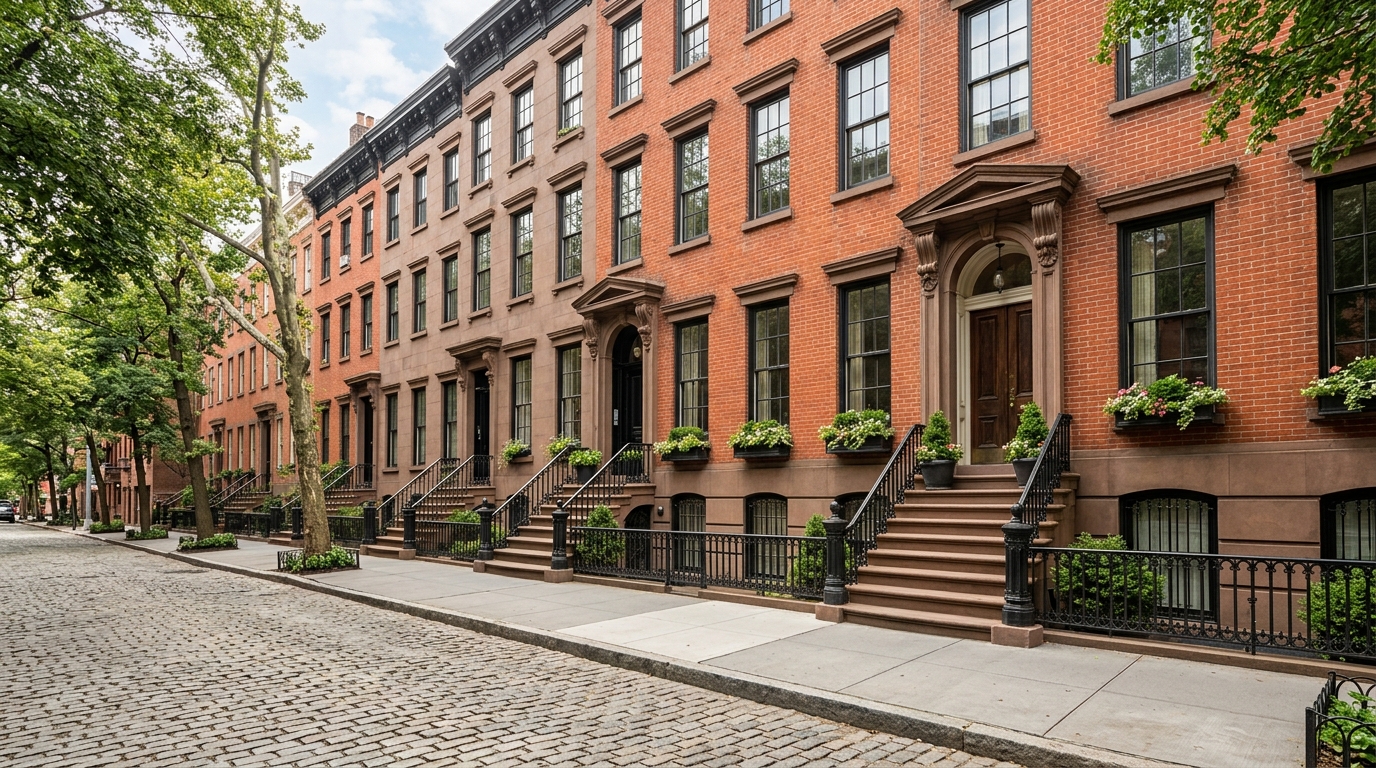
What should I know about the true monthly cost of owning a home in New York, NY?
Your true monthly cost in New York City is the sum of principal and interest, property tax, homeowners insurance, and, for condos and co-ops, monthly…
Your true monthly cost in New York City is the sum of principal and interest, property tax, homeowners insurance, and, for condos and co-ops, monthly common charges or maintenance. On the citywide typical home value of $823,251 as reported by Zillow (updated June 30, 2026), with 20% down at the 6.58% 30-year fixed rate Freddie Mac reported for the week ending July 23, 2026, principal and interest alone runs roughly $4,196 a month. But the sticker price hides an enormous intra-city range, and two homes at the same price can carry very different tax bills depending on whether they fall under Tax Class 1 or Tax Class 2. Add one-time entry taxes at the $1 million line and you have a carry number that looks nothing like a mortgage calculator's first guess. The useful figure is always the neighborhood-and-borough number, not the citywide average.
How do principal and interest anchor the monthly number?
Principal and interest, often shortened to P&I, is the portion of your monthly payment that repays the loan itself plus the lender's charge for borrowing. It is the larger fixed component of your carry, and in a market where loan balances are large, the interest rate drives it more than almost anything else.
Rate sensitivity dominates the monthly on a large NYC balance. A 100-basis-point move, the difference between 6.58% and 7.58%, changes P&I by hundreds of dollars a month on that same loan. The Freddie Mac benchmark reflects a borrower with 20% down and excellent credit, so a weaker credit profile or a smaller down payment pushes your rate and your payment higher.
The citywide average is a starting point, not your number. Manhattan tells a different story: New York County's typical home value is $1,203,663, up 1.5% over the past year per Zillow (updated March 31, 2026). A Tribeca or West Village loan sized to that value carries a materially higher P&I than the citywide figure suggests. The cheapest ZIP code in the five boroughs has a typical value near $238,668; the most expensive tops $3.6 million, a roughly 15x spread inside the same city limits.
Why do Tax Class 1 houses and Tax Class 2 condos carry different tax lines?
NYC assigns residential property to tax classes, and the class, not just the market value, drives the annual tax bill. A one-to-three-family house is Tax Class 1. A condo, co-op, or 4-plus-unit residential building is Tax Class 2. Two homes at the same sale price can carry very different tax bills because each class uses a different assessment ratio, a different tax rate, and, for condos and co-ops, a different valuation method entirely.
The reason condos and co-ops get valued differently is worth understanding: for those units, the assessed value is set using an income approach, based on rental-comparable buildings, rather than on what the unit actually sold for. That method systematically understates high-end condo values, which is why a multi-million-dollar condo in Flatiron or the Meatpacking District can carry a surprisingly modest tax bill relative to its price.
| Dimension | Tax Class 1 house | Tax Class 2 condo/co-op |
|---|---|---|
| Assessment ratio | 6% of market value | 45% of market value |
| FY2026 tax rate | 19.843% | 12.439% |
| Valuation method | Sale-comparable market value | Income (rental-comparable) approach |
Read that table carefully before you assume a house is always cheaper on tax. Class 1's headline rate looks steep, but it applies to only 6% of market value. The Class 2 rate is lower, but it applies to a 45% assessed base. You cannot compare tax bills by rate alone, and modeling a condo's tax off the Class 1 rate is a common and costly error. For a fuller walk through the tradeoffs, this comparison of co-ops and condos and the Manhattan co-op and condo decision guide both dig into how ownership structure changes the math.
Class 1 values are not static, either. In the FY27 tentative assessment roll, Class 1 total market value rose 5.2% to $822.2 billion, with assessed values up 4.7%, according to the NYC Department of Finance (January 15, 2026). Rising assessments feed directly into next year's bill.
What monthly costs does a condo or co-op have that a house does not?
A house carries no building charges; you bear all maintenance directly and there is no monthly bill from an association. A condo adds monthly common charges, and a co-op adds monthly maintenance, which often bundles the building's underlying property tax and, in many buildings, the underlying mortgage. That extra line is the single biggest structural difference between owning a Cobble Hill townhouse and owning a Flatiron condo at the same price.
That common-charge or maintenance line is real money and it recurs every month whether or not you use the amenities. In doorman buildings in the Upper East Side, West Chelsea, or Battery Park City, it can rival a meaningful slice of the mortgage payment. There is no reliable citywide average to quote here, and that is not an oversight. No neutral or government source publishes a verifiable citywide average monthly common-charge or maintenance figure, and listing-portal numbers are too inconsistent to treat as authoritative. The practical move is to get the actual figure from the offering plan or the managing agent for the specific building you are considering, then confirm what the co-op maintenance includes, since a maintenance number that bundles taxes is not comparable to a condo common charge that does not.
Homeowners insurance is the smaller recurring line, but lenders require it. Independent rate studies from insurance-comparison marketplaces put New York State premiums in the range of $140 to $148 a month. Treat that as directional only: those figures are statewide averages from lead-generation comparison sites, not NYC-specific neutral authorities, and a condo owner insures only the interior and contents while a house owner insures the full structure, so your actual quote will vary by building type and coverage.
If you are weighing the two structures, the property-type overviews for NYC condos and NYC co-ops lay out how each affects your monthly stack.
What one-time taxes do I owe when the price crosses $1 million?
At closing you face two acquisition taxes that sit outside your monthly carry: the New York State transfer tax and the mansion tax. Because the citywide typical value is near $900,000 and Manhattan's is well over a million, many NYC purchases land right at or above the first threshold, so these are a real gate on your total cost of entry, not a rounding error.
The mansion tax is an additional tax of 1% of the sale price that applies to residential purchases where the consideration is $1 million or more, per the NY State Department of Taxation and Finance. It is buyer-paid, and it is structured as a cliff, which means the rate applies to the entire price, not just the amount above the threshold. Cross the line at exactly $1 million and you owe $10,000; stop at $999,999 and you owe nothing. That $1 discontinuity costs $10,000, which is why buyers negotiating near the line watch it closely.
The mansion tax then climbs in tiers as price rises. Reflecting the 2019 amendment structure, the rate is 1.0% from $1M to $2M, 1.25% from $2M to $3M, 1.5% from $3M to $5M, 2.25% from $5M to $10M, 3.25% from $10M to $15M, and higher still above that. In Tribeca, West Village, and Greenwich Village, where eight-figure sales are common, these upper tiers matter.
The state transfer tax is computed at two dollars for every $500, or fractional part, of consideration. It is normally paid by the seller (the grantor), but if the seller does not pay or is exempt, the buyer (the grantee) becomes liable, so build a contingency into your closing budget.
Does STAR still help new NYC buyers lower their carry?
STAR, the New York State School Tax Relief benefit, reduces the school-tax portion of a primary residence's property tax bill, which lowers your effective monthly carry. It applies within the City of New York, so it is a genuine input for NYC owner-occupants deciding whether the true recurring cost is manageable.
New NYC buyers instead receive the STAR credit, which delivers the benefit as a check or direct deposit rather than as a reduction on the tax bill itself. The relief is real either way; the mechanism is what changed.
Enhanced STAR, for qualifying seniors, has an income limit of $110,750 for the 2026-2027 benefit year and is based on the first $88,500 of full value. Eligibility for the 2026 benefit is measured against your 2024 tax-year income.
One structural point: STAR applies only to school-district taxes, though within New York City that still counts. And LLC or corporate ownership generally disqualifies a property, so if you are considering titling a purchase through an entity, weigh that against the STAR benefit you would forfeit.
Let’s talk about your block, building, apartment
The right starting move is a conversation with the right broker.
The Right Broker Makes All The Difference