Sutton Place
A five-block residential pocket along the East River from East 53rd to East 59th — six pre-war co-op buildings, a handful of intact 1920s townhouses, and the U.N. Secretary-General’s residence at 3 Sutton Place. One of the quietest addresses in central Manhattan.
A 1920s pocket on the East River that stayed small.
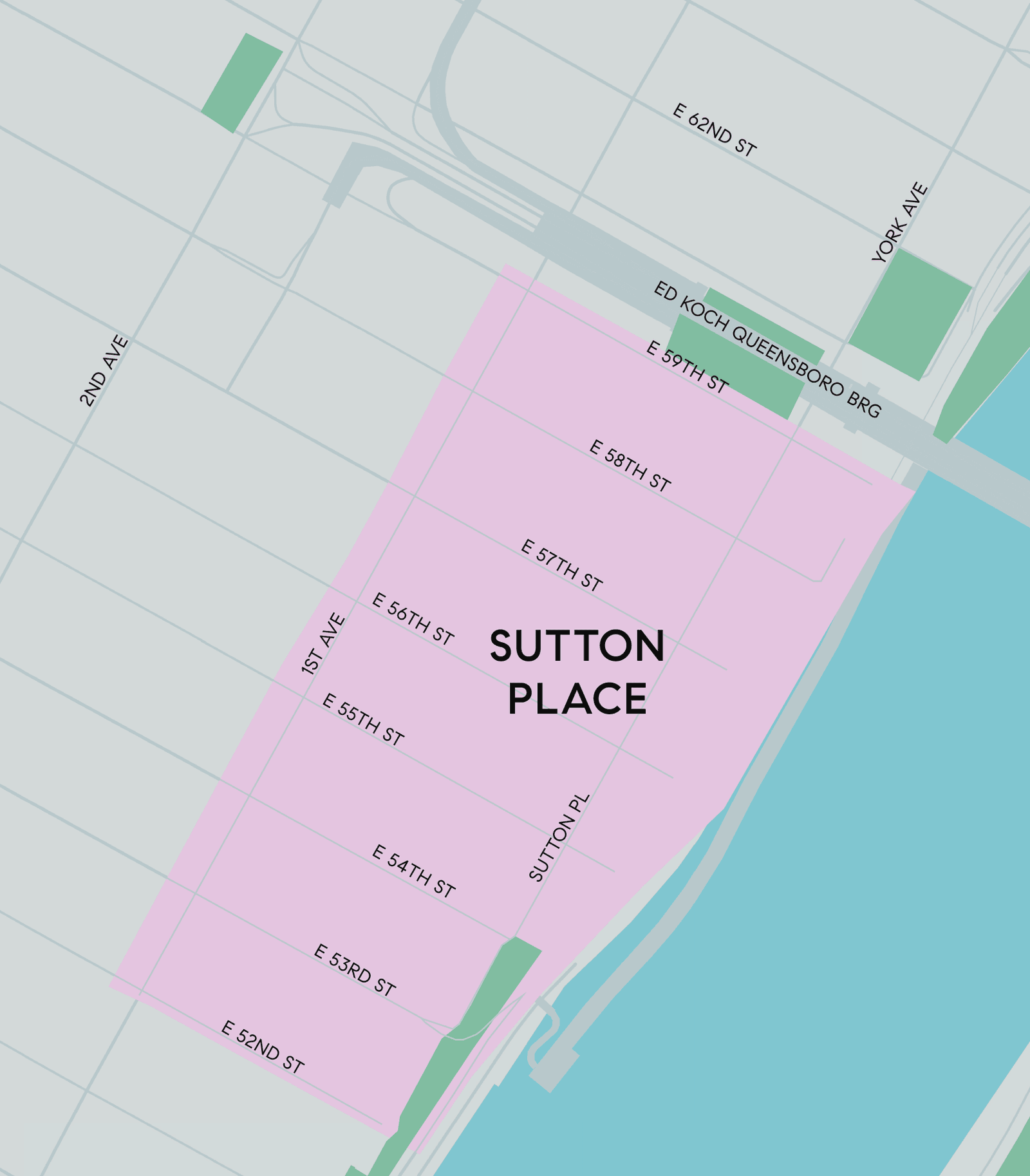
Sutton Place runs from East 53rd Street to East 59th Street, between First Avenue and the East River. The land was acquired in 1837 by an Effingham B. Sutton ancestor as a summer estate on the bluffs above the river; the rowhouses on the block went up in 1875 as Sutton’s brownstones along then-named Avenue A, and the block was renamed Sutton Place in 1883. By the end of World War I the neighborhood had declined into boarding houses sharing the riverfront with the Peter Doelger brewery and the New York Steam Company.
Sutton’s character today was set in a single transformational decade — the 1920s — when Anne Harriman Vanderbilt (widow of William K. Vanderbilt) and Anne Morgan (J.P. Morgan’s daughter) commissioned townhouses on the East River side of the street and pulled the social geography of New York with them. Architect Mott B. Schmidt designed both, working in a Georgian / Neo-Georgian register. The Morgan house at 3 Sutton Place is today the official residence of the Secretary-General of the United Nations.
The pre-war co-op stock on Sutton Place South — 1 Sutton Place South (1926), 25 Sutton Place South, 20 Sutton Place South — was built during the same window, with the same architectural register: limestone-and-brick, formal lobbies, river views, restrained scale. The neighborhood has stayed small, residential, and unusually quiet ever since. The cul-de-sac dead end at 57th and the river-facing buildings give daily life a slower rhythm than the surrounding Midtown East and Upper East Side blocks.
Where Sutton Place trades in 2026.
Data caveats worth knowing. Treat these numbers as directional, not precise. Sutton Place is the smallest core neighborhood in this report — a handful of buildings and a few dozen townhouses — and the monthly median swings wildly between months dominated by one-bedroom co-op trades and months when a 1 Sutton Place South maisonette or a Sutton Square townhouse closes. The sources also disagree: Redfin showed a $1.2M October 2025 median up 23% while PropertyShark showed $795K down 20% in November. The November 2025 condo median of $4.5M (+137% YoY) is almost certainly a single high-end trade against a thin base. For any pricing decision, comp at the building level — building-level data is plentiful precisely because the inventory is so concentrated.
What’s actually for sale.
The defining inventory. 1 Sutton Place South (1926), 25 Sutton Place South, 20 Sutton Place South, 60 Sutton Place South, and a small number of additional buildings on East 57th through East 58th. Most are pre-war 1920s–1930s, river-facing, limestone-and-brick, with formal lobbies and restrained scale.
Sutton Square (a small cul-de-sac off 58th between Sutton Place and the river), Riverview Terrace (a private gated lane of five townhouses from the 1920s), and East 57th between Sutton and First. Schmidt-designed Neo-Georgian along with a small stock of earlier 1875 brownstones. Tightly held; rarely on the open market.
3 Sutton Place — the former Anne Morgan house, designed by Mott B. Schmidt in the 1920s and one of the anchors of the neighborhood’s architectural register.
On Sutton’s periphery toward First Avenue. Easier boards, broader buyer pool, lighter financials than the prime Sutton Place South co-ops.
What it’s like to live here.
Sutton Place Park and the East River.
Three small parks step down to the East River along the eastern edge of the neighborhood — Sutton Place Park at the foot of East 57th, East River Esplanade access at 60th, and a small park at 53rd. The 59th Street Bridge (Ed Koch Queensboro Bridge, completed 1909) frames the northern view, and the Roosevelt Island Tram crosses overhead at 60th and First on its way across the river.
Dining & shops.
Sutton Place is residential; the dining is mostly in the surrounding Midtown East and Beekman blocks. Mr. Chow (324 East 57th) has been there since 1979; Smith & Wollensky (East 49th at Third) since the 1970s. Pinocchio Ristorante (East 60th and First) anchors the Italian end; Le Veau d’Or (East 60th) is the oldest French restaurant in NYC. The D&D Building at 979 Third — eighteen floors of trade-only design showrooms — matters for residents mid-renovation.
The quiet.
The river views and the dead-end-at-57th street pattern make daily life unusually quiet for central Manhattan. Walkability for daily needs is high — the neighborhood is residential and small-grocery dense — and the slower pace is the draw for the downsize-from-larger-UES buyer and the senior-executive relocation pool.
Transit.
Sutton Place sits in a relatively underserved transit pocket; the closest stop is roughly a 5–10 minute walk depending on the block. Walkability for daily needs is high; subway access is the trade-off.
- Lexington Ave / 63rd St — F (5–10 minutes; closest stop)
- Lexington Ave / 59th St — 4 5 6 and N R W (8–12 minutes)
- Lexington Ave / 53rd St — E M (8–10 minutes)
- 51st St — 6 (southern Sutton / Beekman)
- Roosevelt Island Tram — Second Ave and 60th
- East River Ferry — East 34th and East 90th
Schools.
Sutton Place sits in District 2, with a notably strong zoned elementary.
- PS 59 Beekman Hill International (233 East 56th) — zoned K–5, District 2; 2019 National Blue Ribbon school; 14:1 student-teacher ratio; zoned by the U.N. and one of the most internationally diverse public schools in the city.
- PS 116 Mary Lindley Murray (210 East 33rd) — zoned K–5 for southern blocks, District 2.
- Cathedral High School (350 East 56th) — all-girls Catholic, grades 9–12.
- The Beekman School (220 East 50th) — private, grades 9–12 plus post-graduate.
- Within reach on the UES: Brearley, Chapin, Dalton, Spence, Nightingale-Bamford.
Set in the 1920s. Remarkably intact.
The Sutton Place character was set by Mott B. Schmidt’s 1920s Neo-Georgian townhouses for Anne Vanderbilt (1 Sutton Place North), Anne Morgan (3 Sutton Place, now the U.N. Secretary-General’s residence), and a handful of contemporaries who built on the same blocks in the same window. The Schmidt townhouses were inspired by Sir Christopher Wren’s London doorways and remain remarkably intact. The co-op buildings that followed — particularly 1 Sutton Place South (1926) — share the same restrained limestone-and-brick register, formal lobbies, and river-facing positioning. The architectural coherence is unusual for Manhattan: most of the building stock dates from a single 1920s–1930s window.
Practical notes for buyers
- 1 Sutton Place South and the other prime co-op boards run rigorous reviews — 25–40% down, two to three years of post-closing liquidity, full financials, and a board interview. Some buildings restrict financing.
- The small-building reality of Sutton means board scrutiny is often particularly close — every shareholder is more visible than in a 200-unit building, and the boards review packages accordingly.
- Townhouse buyers should plan for the same engineering and party-wall realities as anywhere in pre-war Manhattan, plus the small-scale reality that any exterior renovation is visible to every neighbor.
- Sutton is small enough that listings are sometimes filled off-market via referral before they list publicly. Building relationships matter. (When the Schmidt townhouses do trade, they price aggressively — the Anne Vanderbilt house was reported as a 2024 listing at $21M.)
A market where the building matters more than the marketing.
Sutton Place is a small market where building knowledge, co-op board posture, and the right buyer pool matter more than marketing reach. The co-op estate sale here — a long-tenured owner, an executor, a building with a multi-decade buyer profile — is the kind of work Tracie has been doing through JP Morgan and major NYC firm referrals since 1995.
“Sutton is a quiet market in every sense. The buildings are small, the boards are particular, and the right buyer pool is narrow. The work is matching the building to the buyer who can actually clear board — not casting wide and hoping.”
If you’re thinking about buying or selling in Sutton Place, the right starting move is a conversation about your specific building, your block, and your timing — not a generic walk-through.

Adjacent neighborhoods.
Sutton Place, in plain answers.
What is the average home price in Sutton Place?
The median sale price in Sutton Place is volatile because the neighborhood is small and inventory is thin, and the sources disagree. As of October 2025, Redfin reported a median of $1.2M (+23.1% YoY); November 2025 showed a $795K median (−20.5%); June 2025 ran $1.17M (+20.6% YoY). By property type in November 2025: condo median $4.5M (almost certainly skewed by a single high-end trade), co-op median $775K (−13.2% YoY). Median price-per-square-foot was approximately $826. Treat these as directional and comp at the building level — building-level data is rich because Sutton is so concentrated.
Is Sutton Place a good place to live?
Sutton Place is one of Manhattan’s quietest residential pockets — five blocks of pre-war co-ops, a handful of intact 1920s townhouses, three small East River parks, and an unusual residential coherence for central Manhattan. The U.N. Secretary-General’s residence is at 3 Sutton Place. Daily life is residential-dense and slower-paced than the surrounding Midtown East and UES blocks; the trade-off is that the nearest subway stop is a 5–10 minute walk depending on the block.
What subway lines serve Sutton Place?
The closest stop is Lexington Avenue and 63rd Street (F train, 5–10 minutes). The Lexington and 59th Street complex (4, 5, 6, N, R, W) is 8–12 minutes walking. The E and M at 53rd and the 6 at 51st cover southern Sutton. The Roosevelt Island Tram leaves from Second Avenue and 60th Street, and the East River Ferry has stops at East 34th and East 90th. Walkability for daily needs is high; subway access is the trade-off.
What's the architectural history of Sutton Place?
The land was acquired in 1837 by Effingham B. Sutton’s family; the first rowhouses (1875) were brownstones along what was then Avenue A, and the block was renamed Sutton Place in 1883. The neighborhood declined into boarding houses by World War I, then was transformed in the 1920s when Anne Harriman Vanderbilt and Anne Morgan commissioned Mott B. Schmidt to build Neo-Georgian townhouses on the East River side. The Vanderbilt house (1 Sutton Place North) and the Morgan house (3 Sutton Place, today the U.N. Secretary-General’s residence) anchor the architectural register the surrounding pre-war co-ops adopted.
What schools serve Sutton Place?
PS 59 Beekman Hill International (233 East 56th, K–5, District 2) is the zoned public elementary — a 2019 National Blue Ribbon school with a 14:1 student-teacher ratio, zoned by the U.N. and known as one of the most internationally diverse public schools in the city. PS 116 Mary Lindley Murray serves the southern blocks. Cathedral High School (East 56th) is a private all-girls Catholic high school. The full UES private-school cluster — Brearley, Chapin, Dalton, Spence, Nightingale-Bamford — is within reach.
What are the most desirable buildings on Sutton Place?
1 Sutton Place South (1926) is the prestige co-op address; 25 Sutton Place South, 20 Sutton Place South, and 60 Sutton Place South are the other primary pre-war co-ops. The Schmidt-designed townhouses on Sutton Place North (1, 3, 5) trade rarely and price aggressively when they do. Sutton Square and Riverview Terrace contain small clusters of 1920s rowhouses that are tightly held.
How does the Sutton Place co-op board process work?
The prime co-op boards on Sutton Place South run rigorous reviews — 25–40% down, two to three years of post-closing liquidity, full financials, references, and a board interview. Some buildings restrict financing. The small-building reality of Sutton means board scrutiny is often particularly close — every shareholder is more visible than in a 200-unit building, and the boards review packages accordingly.
Let’s talk about your building.
Tracie Golding — Compass · New York, NY. Selling Manhattan and Brooklyn since 1995.
Schedule a consultation