Tribeca
The cast-iron loft district below Canal — a small, tightly held grid of converted 19th-century warehouses where most apartments are full-floor lofts and most buildings sit inside one of four overlapping Historic Districts.
A 170-year-old warehouse district that survived.
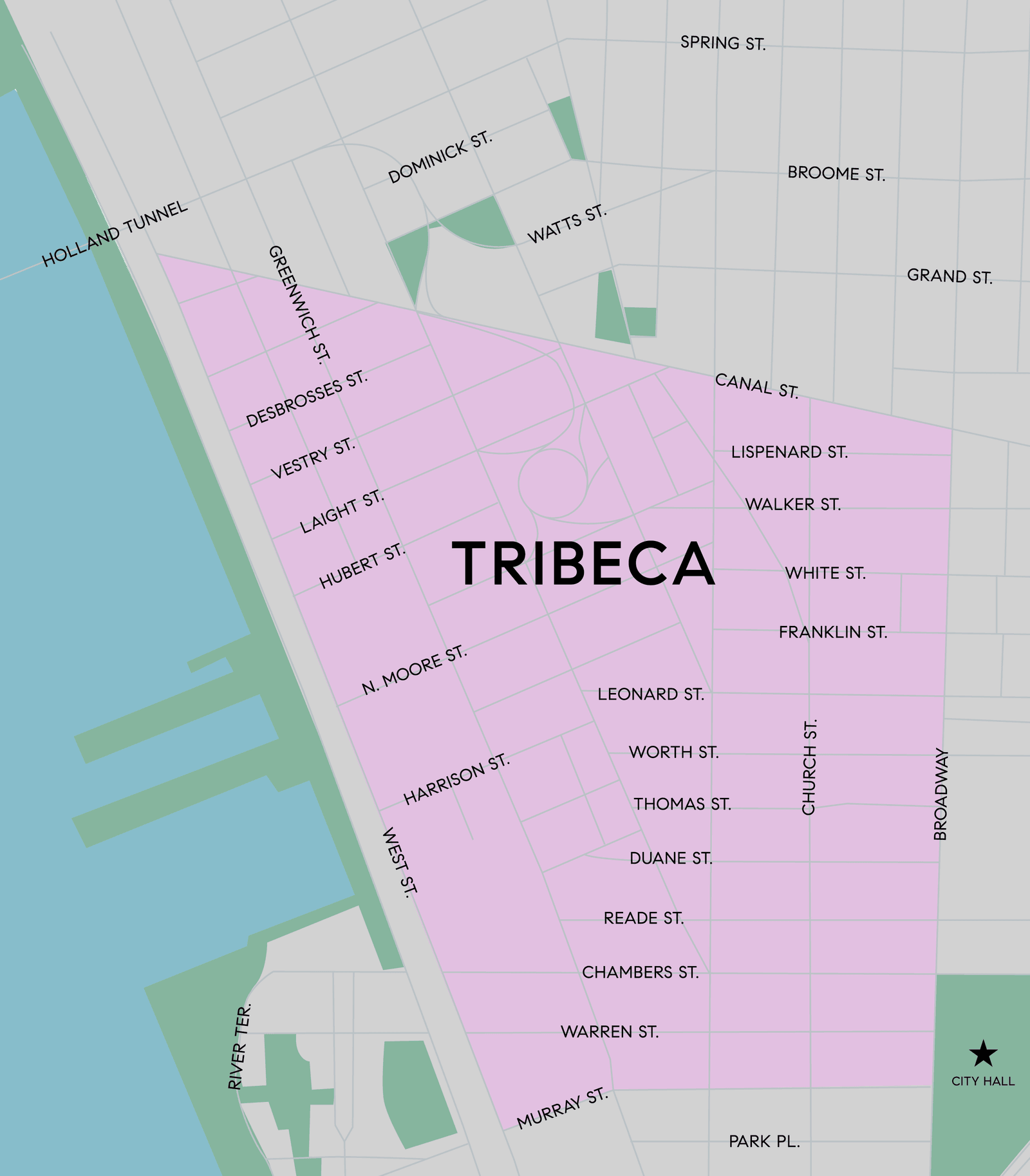
Tribeca occupies the triangle below Canal Street, roughly bounded by Broadway to the east, Vesey to the south, and the Hudson River to the west. The street grid was laid out off Greenwich Street in the early 1800s; the cast-iron warehouses that define the neighborhood today went up between roughly 1850 and 1890, when Washington Market and the Hudson River piers made this the receiving end of the city’s wholesale food and dry-goods trade. The market closed and the piers shut down; the buildings stayed.
The name itself is a 1970s acronym — Triangle Below Canal — coined when artists began moving into the empty warehouses and converting upper floors into raw loft space. By the 1990s those conversions had turned into the most expensive square footage downtown. Four separate Historic Districts (Tribeca North, South, East, and West) were designated between 1991 and 1992; together they protect the cast-iron and brick warehouse stock that gives the neighborhood its single, consistent architectural character.
What survives is one of the largest concentrations of cast-iron architecture in the country, second only to SoHo. The buyer Tribeca draws is specific: people who want a full-floor loft rather than a stacked apartment, who care about ceiling height and column spacing more than building amenities, and who don’t mind paying for the privacy of an elevator that opens directly into the unit.
Where Tribeca trades in 2026.
Data caveats worth knowing. Tribeca medians swing because the trading pool is small and the dollar range is wide — a single full-floor loft trade above $20M can move the monthly number meaningfully. Inventory has risen modestly and days-on-market has lengthened, which means realistic pricing matters more than it did in 2021–2022. Well-priced lofts in the right building still move in two to three months; aspirational listings sit.
What’s actually for sale.
The defining inventory. Full-floor and half-floor conversions in cast-iron and brick warehouses on Franklin, Hubert, Reade, North Moore, Hudson, Greenwich, Duane, and Jay. Ceiling heights typically 11–14 feet; column-and-beam structural systems; many with keyed elevators.
Both ground-up new construction (sparse inside the Historic Districts) and condo-conversion of older buildings. Prime examples on Leonard, Warren, and along Greenwich.
A smaller share than the condo/loft stock; pre-war conversions where the building took the co-op route instead of condo. Stricter board approval, more conservative buyers.
Rare. A handful on Harrison, Hubert, and the side streets — almost never on the open market. When one comes up, it usually trades through a brokered conversation, not a public listing.
What it’s like to live here.
The street pattern.
Unlike most of Manhattan, Tribeca’s grid breaks at angles — Hudson, Greenwich, West Broadway, and Church each carry traffic differently, and the side streets (Franklin, Harrison, Hubert, North Moore, Jay, Beach) are short, quiet, and almost residential despite the commercial zoning. Belgian-block paving survives on several blocks. Strollers and dog walkers outnumber tourists.
The Hudson River side.
Tribeca’s western edge is now Hudson River Park — running uninterrupted from Battery Park up through the West Village. Pier 25 (volleyball, mini-golf, the public dock) and Pier 26 (the recently rebuilt eco-park) are within a five-minute walk of any address west of Greenwich.
Dining.
This is the densest fine-dining belt below 14th Street. The Odeon on West Broadway has been the neighborhood institution since 1980. Locanda Verde at the Greenwich Hotel, Frenchette on Franklin, Marc Forgione on Reade, Tamarind on Hudson, and L’Abeille on Harrison anchor the dinner reservations. Bubby’s at the corner of Hudson and North Moore is the all-day diner most strollers point toward. Grand Banks — the seafood bar on a historic schooner moored at Pier 25 — is a summer-only fixture.
Shops & culture.
The Tribeca Film Festival runs in June. AIRE Ancient Baths on Franklin draws steady traffic year-round. The cast-iron Staple Street Skybridge between Jay and Harrison is one of the most photographed pieces of streetscape in lower Manhattan. Hook & Ladder Company 8 on North Moore — the Ghostbusters firehouse — still has the logo painted on the sidewalk out front.
Transit.
Multiple subway nodes plus PATH and ferry. Walk Score is 98 — among the highest in the city.
- Franklin Street — 1
- Chambers Street — 1 2 3 and A C
- Centre Street Complex — J Z
- World Trade Center / Fulton Center — 2 3 4 5 A C J R Z and E, plus PATH to Hoboken & Jersey City
- NYC Ferry — Pier 11 and Battery Park City landings
Schools.
PS 234 Independence School (292 Greenwich Street, K–5) and PS 397 Spruce Street School (12 Spruce Street, K–8) are the zoned District 2 public elementaries, both serving Tribeca; PS 234 is long considered one of the strongest downtown elementaries. Private options include Washington Market School (pre-K) and the broader District 2 private network.
Originally Built 1850 to 1910.
The four Tribeca Historic Districts — West (1991), North, South, and East (all 1992) — protect the cast-iron and brick warehouse stock that gives the neighborhood its visual coherence. What you see on the street is what was built between roughly 1850 and 1910: Italianate dry-goods stores, Romanesque Revival warehouses, neo-Grec store-and-loft buildings, a handful of pre-Civil-War survivors.
Practical notes for buyers
- Many buildings carry meaningful capital reserves and ongoing facade work — assessment history matters. Ask for three years of board minutes.
- The Historic District designation means exterior changes — windows, storefronts, signage — go through the Landmarks Preservation Commission. It protects value; it also extends renovation timelines.
- Per-foot pricing in the prime Historic District core runs well above $2,000 and into $3,000+ for trophy floors. Smaller condos away from the cast-iron blocks (toward the south end, around Chambers) trade at meaningful discounts.
A building-by-building market.
Tracie lives in prime Tribeca, and it is one of the Manhattan markets she has worked since she started in NYC real estate in 1995. Her practice in the neighborhood has covered the range of property the area offers — full-floor cast-iron lofts, apartments along Greenwich, and a handful of the harder-to-find townhouses on the side streets.
“Two lofts on the same block can price thirty percent apart based on column placement, ceiling height, and which floor the elevator opens onto. The neighborhood average is the worst possible number to make a pricing decision with.”
If you’re thinking about buying or selling in Tribeca, the right starting move is a conversation about your specific building, your block, and your timing — not a generic walk-through.

Adjacent neighborhoods.
Tribeca, in plain answers.
What is the average home price in Tribeca?
The median sale price in Tribeca was approximately $3.8M in April 2026, with median listings around $4.62M. PropertyShark recorded a January 2026 median of $3.75M, up 15% year-over-year. Because inventory is thin and the price range is wide, monthly medians swing on a small number of trades — look at recent comparables in the same building or block, not the neighborhood average.
Is Tribeca a good neighborhood to live in?
Tribeca is consistently ranked among the most desirable neighborhoods in Manhattan, with a Walk Score of 98, direct subway access on multiple lines, Hudson River Park along its western edge, a deep concentration of restaurants, and one of the strongest public elementary schools downtown (PS 234). The neighborhood draws buyers who value cast-iron loft architecture, full-floor privacy, and a relatively quiet residential rhythm.
What are the best streets in Tribeca?
Each block has a different feel. When walking around the neighborhood buyers will get a sense of what feels right for them.
How are the schools in Tribeca?
The zoned District 2 public elementary schools are PS 234 Independence School (292 Greenwich Street, K-5), long considered one of the strongest downtown elementaries, and PS 397 Spruce Street School (12 Spruce Street, K-8). PS 150 Tribeca Learning Center, which can be applied to as a resident of District 2, moved into a new 8-story building on Greenwich Street in 2022. Private options include Washington Market School (pre-K) and the broader District 2 private network.
What subway lines serve Tribeca?
Tribeca is served by the 1 at Franklin Street and Canal Street; the 1, 2, 3 at Chambers Street; the A, C, J, Z at Chambers/Centre Street; the A, C, E and N, Q, R, W, 6 at Canal Street; and the E plus PATH at the World Trade Center / Fulton Center Complex (2, 3, 4, 5, A, C, J, R, Z). NYC Ferry serves Pier 11 and Battery Park City. Walk Score is 98.
Is Tribeca a historic district?
Yes. Tribeca contains four distinct Historic Districts designated by the NYC Landmarks Preservation Commission: Tribeca West (May 1991), and Tribeca North, South, and East (all December 1992). Together they protect the cast-iron and brick warehouse stock built roughly between 1850 and 1910. Exterior changes to landmarked buildings — windows, storefronts, signage, cornices — require LPC approval.
What is a Tribeca loft?
Most 'lofts' in Tribeca are units inside condo or co-op buildings — the term refers to the layout (open plan, high ceilings, column-and-beam structure, often full-floor) rather than the ownership structure. A Tribeca loft in a converted cast-iron warehouse trades on ceiling height, column spacing, and the privacy of an elevator that opens directly into the unit.
Let’s talk about your building.
Tracie Golding — Compass · New York, NY. Selling Manhattan and Brooklyn since 1995.
Schedule a consultation