Upper West Side
The western counterweight to the Upper East Side — Central Park West’s twin-tower co-ops, Broadway’s working retail spine, and Riverside Drive’s Hudson-facing pre-wars. A more family-heavy, more architecturally varied co-op market than the East Side.
A co-op district built in twenty years.
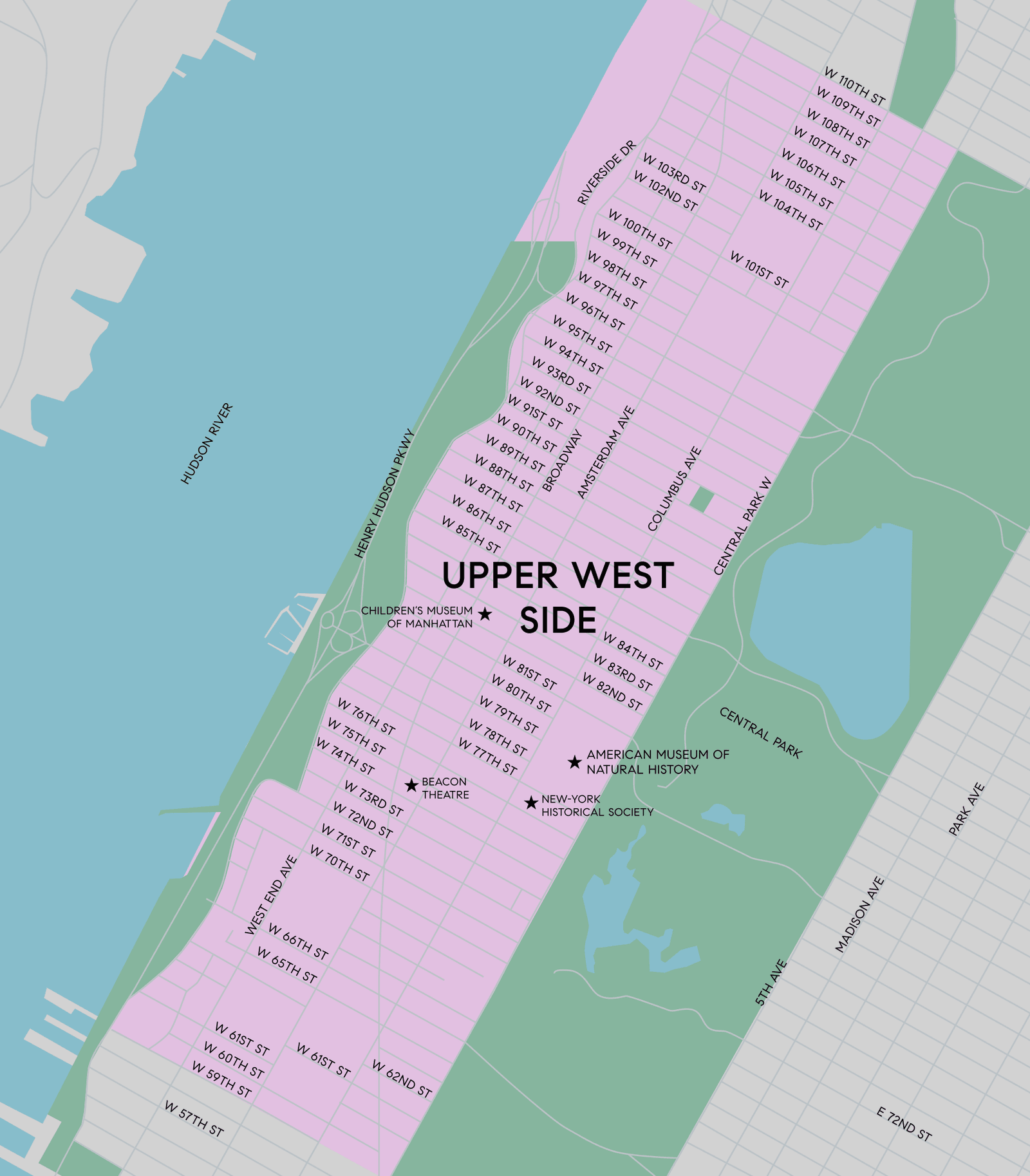
The Upper West Side runs from 59th Street to 110th Street, between Central Park West and the Hudson River. Development came later than the East Side: the area was largely undeveloped into the 1880s. The opening of the Ninth Avenue Elevated, the IRT subway in 1904, and — decisively — the construction of the Dakota in 1884 turned the neighborhood into a high-density apartment-building district within twenty years. By 1930, Central Park West had its full skyline of twin-tower limestone co-ops; Broadway and West End Avenue had filled in with substantial pre-war apartment houses; and Riverside Drive had its own row of grand co-ops facing the Hudson.
The defining architectural moment is the Central Park West Historic District (National Register, 1982), which protects the run of pre-war apartment houses from 61st to 97th and includes the four “grand dames” — the Dakota (Henry Hardenbergh, 1884), the San Remo (Emery Roth, 1930), the Beresford (Roth, 1929), and the Eldorado (Roth and Margon & Holder, 1931). The broader Upper West Side / Central Park West Historic District was designated by the city in 1990 and covers a much larger area east of West End Avenue.
The Upper West Side draws a specific buyer: people who want pre-war scale and architecture, Central Park access on the east side and Riverside Park on the west, and a more low-key, less formal culture than the Upper East Side. Lincoln Center is the cultural anchor in the 60s. The neighborhood is a long-standing family market — Trinity, Collegiate, and several strong zoned public elementaries pull buyers in for the K–12 stretch.
Where the Upper West Side trades in 2026.
Data caveats worth knowing. The UWS reads as a buyer’s market on inventory but tightens fast at the building level. The Central Park West landmark buildings — Dakota, San Remo, Beresford, Eldorado, Century, Majestic — trade against a different curve than the West End Avenue or Amsterdam co-ops one or two avenues over. Condo medians are skewed higher by a small number of new-development buildings (15 Central Park West, 200 Amsterdam, the Beresford-line conversions); take the $2.4M condo median with property-type context. Pricing decisions live at the building and line level.
What’s actually for sale.
The marquee buildings — the Dakota, San Remo, Beresford, Eldorado, Century, Majestic, Kenilworth, Langham. Twin-tower limestone co-ops with A-line park views, strict boards, and full-time staff.
Large stock, often family-size layouts in 3- and 4-bedrooms, generally less stringent boards than CPW. West End and Riverside carrying costs per square foot tend to run below the Central Park West marquee lines.
A mix of newer development (15 CPW, the Aldyn, the Avery, 200 Amsterdam, 222 West 80th) and conversions; concentrated along Broadway and the Riverside Boulevard run in the 60s.
On the side streets between CPW and Amsterdam, and on West End. The spread is wide on condition; carriage-house inventory is minimal.
Concentrated on Riverside Boulevard (Trump-era development) and selective Broadway sites.
What it’s like to live here.
Central Park & Riverside Park.
Two parks, two characters. Central Park runs the east boundary; Riverside Park (Frederick Law Olmsted, 1875, extended 1937 by Robert Moses) runs the Hudson — 4 miles of cliffside park, the 79th Street Boat Basin, the Soldiers’ and Sailors’ Monument at 89th. Riverside is less programmed than Central Park and more the daily-life park for residents.
Lincoln Center.
Lincoln Center for the Performing Arts (1962) anchors the 60s — eleven resident organizations including the Metropolitan Opera, New York Philharmonic, New York City Ballet, Juilliard, the Lincoln Center Film Society, and the Vivian Beaumont Theater. The David Geffen Hall renovation reopened in 2022.
Dining & shops.
The retail spine is Broadway and Columbus — more day-to-day than destination, with a deep neighborhood-restaurant culture. Zabar’s (Broadway at 80th) has been the family-owned food headquarters since 1934; the smoked-fish counter is the local order. Barney Greengrass (Amsterdam at 86th) has been the appetizing institution since 1908. Tatiana by Kwame Onwuachi inside David Geffen Hall opened in 2022 and is one of the harder reservations in the city. Café Fiorello handles pre-performance Italian opposite Lincoln Center, PJ Clarke’s Lincoln Square is the burger fallback opposite the Met Opera, Gray’s Papaya (Broadway at 72nd) the hot dog, Jacob’s Pickles the brunch line, and Levain Bakery (74th between Amsterdam and Columbus) the cookies.
Transit.
Multiple lines converge under Broadway and Central Park West, plus crosstown buses through the park.
- 1 local under Broadway — 59th/Columbus Circle, 66th/Lincoln Center, 72nd, 79th, 86th, 96th, 103rd, 110th
- 2 3 express under Broadway — 72nd, 96th, 110th (Cathedral Pkwy)
- B C local under Central Park West — 72nd, 81st (American Museum of Natural History), 86th, 96th, 103rd, 110th (Cathedral Pkwy)
- A B C D express at 59th/Columbus Circle
- Crosstown buses (M66, M72, M79, M86, M96) across the park
Schools.
Deep choice across public and private, all on the public side in District 3.
- PS 199 Jesse Isidor Straus (270 West 70th) — top-tier zoned K–5
- PS 87 William Sherman (160 West 78th) — long-standing UWS public anchor, K–5
- PS 9 Sarah Anderson (100 West 84th) — zoned K–5
- PS 166 Richard Rodgers (132 West 89th) — zoned K–5
- Trinity School (139 West 91st) — K–12, founded 1709, highly selective
- Collegiate (301 Freedom Place South / Riverside Boulevard) — all-boys K–12, founded 1628; new campus opened 2018
- Calhoun (433 West End at 81st) — co-ed K–12, progressive
- Bank Street School for Children (Riverside at 112th) — progressive K–8
Built by 1930. Roth, Chanin, Hardenbergh.
The Central Park West “grand dames” set the tone: the Dakota (1 West 72nd, Henry Hardenbergh, 1884), NYC’s oldest surviving luxury apartment building, in brick and sandstone with terracotta detail; the Beresford (211 CPW, Emery Roth, 1929), the only tri-tower Roth design on the avenue; the San Remo (145–146 CPW, Roth, 1930), the first twin-towered residential building in the city; the Eldorado (300 CPW, Roth with Margon & Holder, 1931), the Century (25 CPW, Irwin Chanin, 1931), and the Majestic (115 CPW, Chanin, 1931), all Art Deco twin towers — joined by the Kenilworth, Langham, Prasada, Ardsley, Alden, and Oliver Cromwell. West End Avenue and Riverside Drive carry larger family-size pre-wars; the 70s–90s side streets between CPW and Amsterdam hold Italianate, Romanesque Revival, and Renaissance Revival brownstones; new-construction condos run along Riverside Boulevard and at 15 CPW (Stern, 2008) and 200 Amsterdam (2021).
Practical notes for buyers
- CPW landmark co-op boards run rigorous packages — expect 25–35% down minimum, post-closing liquidity of two to three years, full financials, references, and a board interview. The Dakota in particular has a reputation for difficulty with its review.
- 15 CPW, by contrast, is a condo with a much lighter review and a broader buyer pool than the marquee co-op lines.
- West End and Riverside co-ops are often more flexible — family-size apartments and lower carrying costs per square foot than CPW.
- Building reserves and the capital plan matter: the pre-war stock is approaching or past 100 years old, and assessments for facade, elevator, and risers are part of the cost of ownership. Ask for the recent board minutes and assessment history.
A building-by-building market.
The UWS is the kind of market where building knowledge compounds. A Beresford C-line, an Eldorado high-floor tower, a Riverside Drive 4-bedroom, and a West End classic-six are four different buyer pools and four different pricing curves. Tracie has worked the building stock here since 1995 and treats every listing as a building-specific exercise rather than a neighborhood-average one.
“I’m very detail-oriented regarding comps and numbers, because everything’s a very transparent world. The right price for a CPW tower line isn’t the right price for a West End classic-six two blocks over. You determine it building-by-building, not by neighborhood average.”
If you’re thinking about buying or selling in Upper West Side, the right starting move is a conversation about your specific building, your block, and your timing — not a generic walk-through.

Adjacent neighborhoods.
Upper West Side, in plain answers.
What is the average home price on the Upper West Side?
Median asking price on the Upper West Side was about $1.61M as of May 2026, with closed median sale prices running $1.4M–$1.65M depending on the month. The condo median ran $2.4M (up 3.6% YoY in January 2026); the co-op median ran $1.2M (up 18.1% YoY). Price per square foot spans $1,200–$3,500+ depending on building and floor. Inventory was ~577 listings in May 2026 with ~14.4 months of supply, which makes it a buyer-favorable market overall — though Central Park West marquee buildings trade against a tighter curve.
Is the Upper West Side a good place to live?
The Upper West Side is one of Manhattan’s largest and most family-oriented residential neighborhoods — Central Park on the east, Riverside Park on the west, Lincoln Center for performing arts, deep school choice (PS 199, PS 87, Trinity, Collegiate, Calhoun), strong food retail (Zabar’s, Fairway, Citarella), and a five-line subway grid. Pre-war architecture on Central Park West and West End Avenue is among the most intact in the city.
What subway lines serve the Upper West Side?
The 1 runs local under Broadway with stops at Columbus Circle (59th), Lincoln Center (66th), 72nd, 79th, 86th, 96th, 103rd, and 110th. The 2 and 3 are express on the same line with stops at 72nd, 96th, and Cathedral Parkway (110th). The B and C run local under Central Park West with stops at 72nd, 81st (American Museum of Natural History), 86th, 96th, 103rd, and 110th. The A, B, C, and D all stop at 59th/Columbus Circle.
What are the most desirable buildings on the Upper West Side?
The Central Park West landmark co-ops — the Dakota (1884), the Beresford, the San Remo, the Eldorado, the Century, the Majestic, the Kenilworth, the Langham — are the prestige stock. 15 Central Park West (Stern, 2008) is the marquee post-war condo. West End Avenue and Riverside Drive pre-wars offer larger family-size apartments, often at lower price-per-foot than CPW.
What schools serve the Upper West Side?
Public: PS 199 Jesse Isidor Straus (West 70th, K–5), PS 87 William Sherman (West 78th, K–5), PS 9 Sarah Anderson (West 84th), PS 166 Richard Rodgers (West 89th). All District 3. Private: Trinity School (founded 1709, K–12, West 91st), Collegiate (founded 1628, all-boys K–12, Riverside Boulevard), Calhoun (co-ed K–12, West End at 81st), Bank Street School for Children (Riverside at 112th).
How does the Upper West Side co-op board process compare to the Upper East Side?
CPW landmark co-ops run reviews comparable to the strictest UES Park and Fifth boards — 25–35% down, two to three years’ post-closing liquidity, full financials, references, and a board interview. The Dakota is well-known for a rigorous process. West End and Riverside co-ops are typically more flexible than CPW; broadly the UWS culture is slightly less formal than the UES at equivalent price points, but the building’s posture matters more than the neighborhood’s.
Is the Upper West Side a historic district?
Yes — the Central Park West Historic District was added to the National Register of Historic Places in 1982, covering the run of pre-war apartment houses on CPW from 61st to 97th. The much larger Upper West Side / Central Park West Historic District was designated by the NYC Landmarks Preservation Commission in 1990 and extends east of West End Avenue across most of the residential core.
Let’s talk about your building.
Tracie Golding — Compass · New York, NY. Selling Manhattan and Brooklyn since 1995.
Schedule a consultation