What should I know about the day-to-day differences between Tribeca and West Village?
Tribeca and the West Village sit less than a mile apart in Lower Manhattan, but they feel like two different cities on foot.
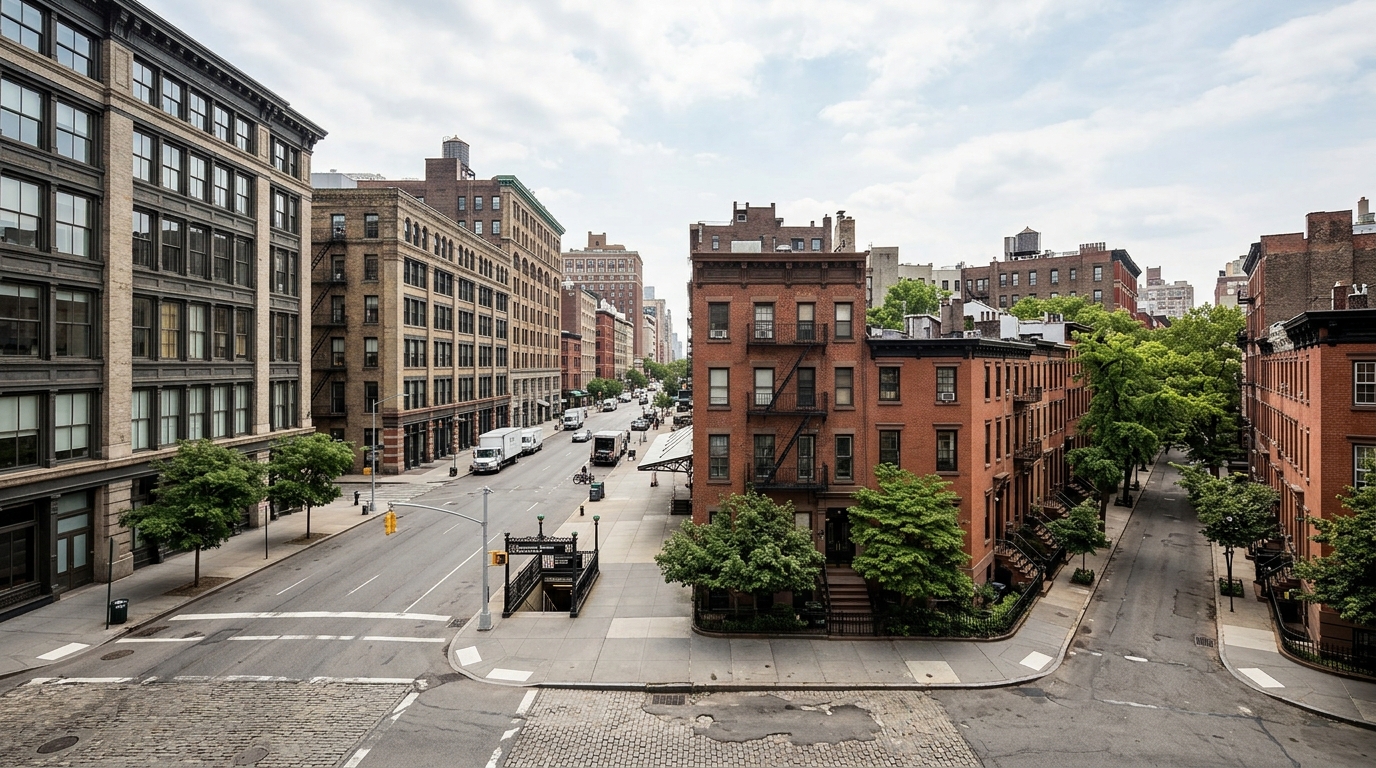
Tribeca and the West Village sit less than a mile apart in Lower Manhattan, but they feel like two different cities on foot. Tribeca reads open and legible: wide former-industrial blocks, cast-iron loft buildings, and an express subway at Chambers Street. The West Village reads intimate and maze-like: pre-1811 crooked lanes, low brick and brownstone rowhouses, and a village hush that Tribeca's harder architecture does not have. The practical differences that shape daily life come down to five things: how easily you find your way around, what kind of home you can buy, how you commute, which civic bodies govern the streets, and how strict the landmark rules are. Tribeca is part of Manhattan Community District 1; the West Village belongs to Community District 2 within greater Greenwich Village. Neither is objectively better. The right pick depends on whether you want grid clarity and loft scale or off-grid character and rowhouse scale.
Is Tribeca easier to navigate on foot than the West Village?
Tribeca is meaningfully easier to navigate because its streets follow a near-regular geometry, while the West Village keeps a tangled pre-grid pattern that predates the Manhattan street plan.
Tribeca's blocks were laid out at right angles off Greenwich Street and on a diagonal off Broadway, which produces irregular block lengths and a few odd open spaces, but the overall logic is still angular and readable. You can orient yourself by Greenwich, Hudson, and West Broadway and hold a mental map. The name itself, the "Triangle Below Canal," tells you the shape.
The West Village is the exception to Manhattan's orderly grid. When the Commissioners' Plan of 1811 imposed the numbered-street system on the island, it stopped short of this area, leaving the older road pattern intact (Wikipedia, "West Village"). That is why West 4th Street famously crosses West 10th, 11th, 12th, and 13th, and why Perry, Charles, and Bank Streets bend in ways that defeat GPS. If you value the feeling of getting lost on a quiet residential lane lined with trees, the West Village delivers it. If you want to walk home from the subway on autopilot after a long day, Tribeca's clarity is a real daily convenience.
For a fuller street-by-street picture, my Tribeca neighborhood overview and West Village neighborhood overview walk through the individual pockets.
What kind of buildings and apartments dominate each neighborhood?
Tribeca is dominated by large-floorplate loft conversions in 19th-century warehouse and factory buildings, while the West Village is dominated by low-rise Federal and Greek Revival rowhouses. That single distinction drives most of what you will actually live in.
A loft, in this context, is a residence carved out of former commercial or industrial space, so it tends to offer big windows, high ceilings, open floor plans, and wide column-free spans. Tribeca's building fabric is exactly that kind of stock. When the New York City Landmarks Preservation Commission designated the Tribeca West Historic District on May 7, 1991, the district covered 17 blocks and roughly 220 buildings, mostly warehouses, factories, and office towers built between 1860 and 1910 (Wikipedia, "Tribeca West Historic District"). Many of those mercantile structures are now residential lofts and full-floor condos.
The West Village housing story is the opposite in scale. Elegant brick and brownstone rowhouses rose along Hudson, Barrow, and Commerce Streets in Federal and Greek Revival styles, and those small-scale townhouses and walk-ups still set the tone. Expect narrower floorplates, more period detail, more prewalk-up co-ops, and more single-family and small-multi townhouses than you find in Tribeca.
The buyer implication is direct. If you want a wide-open loft or a full-floor condo, Tribeca offers deeper inventory of that product. If you want a townhouse, a garden apartment, or a smaller unit inside a historic rowhouse, the West Village is where that stock concentrates. Buyers weighing the two often also compare SoHo against Tribeca because the loft-conversion character overlaps, and compare Greenwich Village against the West Village since the latter sits inside the former.
Which neighborhood has better subway and commuter-rail access?
Both neighborhoods are transit-rich, but Tribeca's anchor is an express subway station and the West Village's anchor is a local subway station plus a PATH connection to New Jersey. Your commute destination decides which matters more.
Tribeca's main station, Chambers Street on the IRT Broadway, Seventh Avenue Line at Chambers Street and West Broadway, is an express stop served by the 1 and 2 trains at all times and the 3 at all times except late nights, and it is ADA-accessible (Wikipedia, "Chambers Street station (IRT Broa...). Express service means fewer stops on longer trips, and the station recorded 3,952,229 riders in 2024, ranking 71st of 423 stations.
The West Village's anchor, Christopher Street, Stonewall, is a local station on the same IRT line, served by the 1 at all times and the 2 during late nights (Wikipedia, "Christopher Street, Stonewall sta...). It logged 3,005,038 riders in 2024. Local service means every stop, which is fine for shorter hops but slower on a long north-south run than Tribeca's express.
Where the West Village pulls ahead is regional rail. The Christopher Street PATH station at 137 Christopher Street sits on the Uptown Hudson Tubes, owned by the Port Authority of New York and New Jersey, giving direct access to Hoboken, Jersey City, and Newark (Wikipedia, "Christopher Street station (PATH)"). If your work or family ties reach into New Jersey, that single connection can outweigh Tribeca's express advantage. Both areas are also linked by the M8 bus, which runs mostly along Eighth, Ninth, Tenth, and Christopher Streets through the West Village and Greenwich Village.
Are Tribeca and the West Village governed by the same community board and police precinct?
No. Tribeca and the West Village fall under different community boards and different police precincts, which affects who governs local land use, quality-of-life issues, and neighborhood policing. This is the difference buyers most often overlook.
A community board is a local advisory body that reviews land-use, liquor-license, and quality-of-life matters for a defined district. Tribeca is part of Manhattan Community District 1, whose three neighborhoods are Battery Park City, Civic Center, Financial District, Greenwich South, Seaport, and Tribeca (Manhattan Community Board 1 - About the District). Tribeca's primary ZIP codes are 10007 and 10013 (Wikipedia, "Tribeca").
The West Village belongs to Manhattan Community District 2, which covers Greenwich Village, West Village, South Village, NoHo, SoHo, Little Italy, NoLIta, and part of Chinatown (Wikipedia, "Manhattan Community Board 2"). The West Village is patrolled by the 6th Precinct of the NYPD (Wikipedia, "West Village").
There is also an identity difference worth naming. Tribeca is a discrete, standalone neighborhood. The West Village is not standalone; it is the western section of the larger Greenwich Village neighborhood, west of Seventh Avenue. So when you are dealing with a local land-use hearing, a block-association question, or a precinct contact, the three neighborhoods route to entirely separate civic channels.
How do the historic-district protections compare between the two areas?
Both neighborhoods carry landmark protection, but the West Village sits inside one enormous, decades-old historic district, while Tribeca is covered by several smaller districts designated much later. A historic district is an area where the Landmarks Preservation Commission must approve exterior alterations, so the regime you fall under shapes what you can change on a building.
The West Village lies largely within the Greenwich Village Historic District, which the Landmarks Preservation Commission designated on April 29, 1969. At designation it held more than 2,000 buildings across 65 blocks and was the larger such district in the city, a distinction it still holds today (NYC LPC press release). That means broad, long-standing, uniform protection over a very large low-rise fabric.
Tribeca's protection came later and in pieces. The Tribeca West Historic District was designated in 1991, and the neighborhood is covered by several separate LPC districts rather than one blanket zone. The practical upshot for a buyer planning a renovation: in either neighborhood, exterior work on a landmarked building needs LPC review, but you should confirm the specific district a given address falls in, because coverage is not continuous across every Tribeca block the way it is across most of the West Village.
How do Tribeca and the West Village compare at a glance?
The table below summarizes the civic, transit, and housing distinctions that shape daily life in each neighborhood.
| Dimension | Tribeca | West Village |
|---|---|---|
| Community district | Manhattan Community District 1 | Manhattan Community District 2 |
| Police precinct | 1st Precinct (per CB1) | 6th Precinct |
| Street pattern | Right-angle off Greenwich St, diagonal off Broadway | Pre-1811 off-grid lanes |
| Dominant housing | Loft conversions, 1860-1910 warehouses | Federal/Greek Revival rowhouses |
| Anchor subway | Chambers St (1/2/3), express, ADA | Christopher St, Stonewall (1; 2 late nights), local |
| Regional rail | Not the primary anchor | Christopher St PATH to New Jersey |
How can I verify which neighborhood actually fits my daily routine?
Test the three neighborhoods against your real week rather than a floor plan, because the differences that wear on you or delight you are the walk to the train, the block quiet at night, and the errand radius. Here is a concrete way to check each one before you commit.
First, walk both anchor commutes at the time you would actually travel. Time the route from a candidate building to Chambers Street in Tribeca versus Christopher Street, Stonewall in the West Village, and if you have a New Jersey tie, ride the PATH from Christopher Street once to feel the real door-to-door number.
Second, confirm the civic and landmark specifics for the exact address. Check which community district and precinct the building sits in, and look up the LPC historic-district status, since a landmarked exterior changes what you can renovate.
Third, match the housing type to how you live. If you want open loft space, weight Tribeca; if you want a rowhouse or a smaller unit with period detail, weight the West Village.
If you want that comparison run against your budget and commute, my side-by-side Tribeca and West Village comparison and a neighborhood-fit consultation are built for exactly this decision. Buyers newer to the market may also want the guide to buying NYC real estate.
Frequently Asked Questions
Are Tribeca and West Village in the same community board?
No. Tribeca is part of Manhattan Community District 1, alongside Battery Park City, the Financial District, and the Seaport. The West Village is part of Manhattan Community District 2, which also covers Greenwich Village, SoHo, and NoLIta. They route to separate community boards for land-use and quality-of-life matters.
Which neighborhood is easier to walk around, Tribeca or West Village?
Tribeca is easier to navigate on foot. Its streets follow a near-regular angular geometry off Greenwich Street and Broadway, so you can hold a mental map. The West Village keeps a pre-1811 off-grid pattern of bending lanes, which many people love for its character but which makes wayfinding harder.
Does the West Village have direct access to New Jersey?
Yes. The Christopher Street PATH station at 137 Christopher Street sits on the Uptown Hudson Tubes, owned by the Port Authority of New York and New Jersey, and connects the West Village directly to Hoboken, Jersey City, and Newark. Tribeca does not have this PATH connection as its primary transit anchor.
What type of apartments are most common in Tribeca versus the West Village?
Tribeca is dominated by loft conversions inside 19th-century warehouse and factory buildings, offering large floorplates, high ceilings, and open plans. The West Village is dominated by low-rise Federal and Greek Revival rowhouses and townhouses, meaning narrower floorplates, more period detail, and more small-multi and single-family homes.
Is the West Village part of Greenwich Village?
Yes. The West Village is the western section of the larger Greenwich Village neighborhood in Lower Manhattan, generally the portion west of Seventh Avenue and bounded by the Hudson River and 14th Street. Tribeca, by contrast, is a discrete standalone neighborhood, the Triangle Below Canal Street.
How do the historic-district protections compare between Tribeca and the West Village?
The West Village sits largely within the Greenwich Village Historic District, designated in 1969 with more than 2,000 buildings across 65 blocks, still the larger in the city. Tribeca is covered by several smaller districts designated later, starting with the Tribeca West Historic District in 1991. Confirm a specific address, since Tribeca coverage is not continuous.
Let’s talk about your block, building, apartment
The right starting move is a conversation with the right broker.
The Right Broker Makes All The Difference