Cobble Hill
A twenty-two-block enclave of 19th-century brownstones between Atlantic Avenue and Degraw Street — quieter than Brooklyn Heights above it, tighter than Carroll Gardens below, and one of the most intact mid-19th-century streetscapes in the country.
Twenty-two blocks the 19th century left intact.
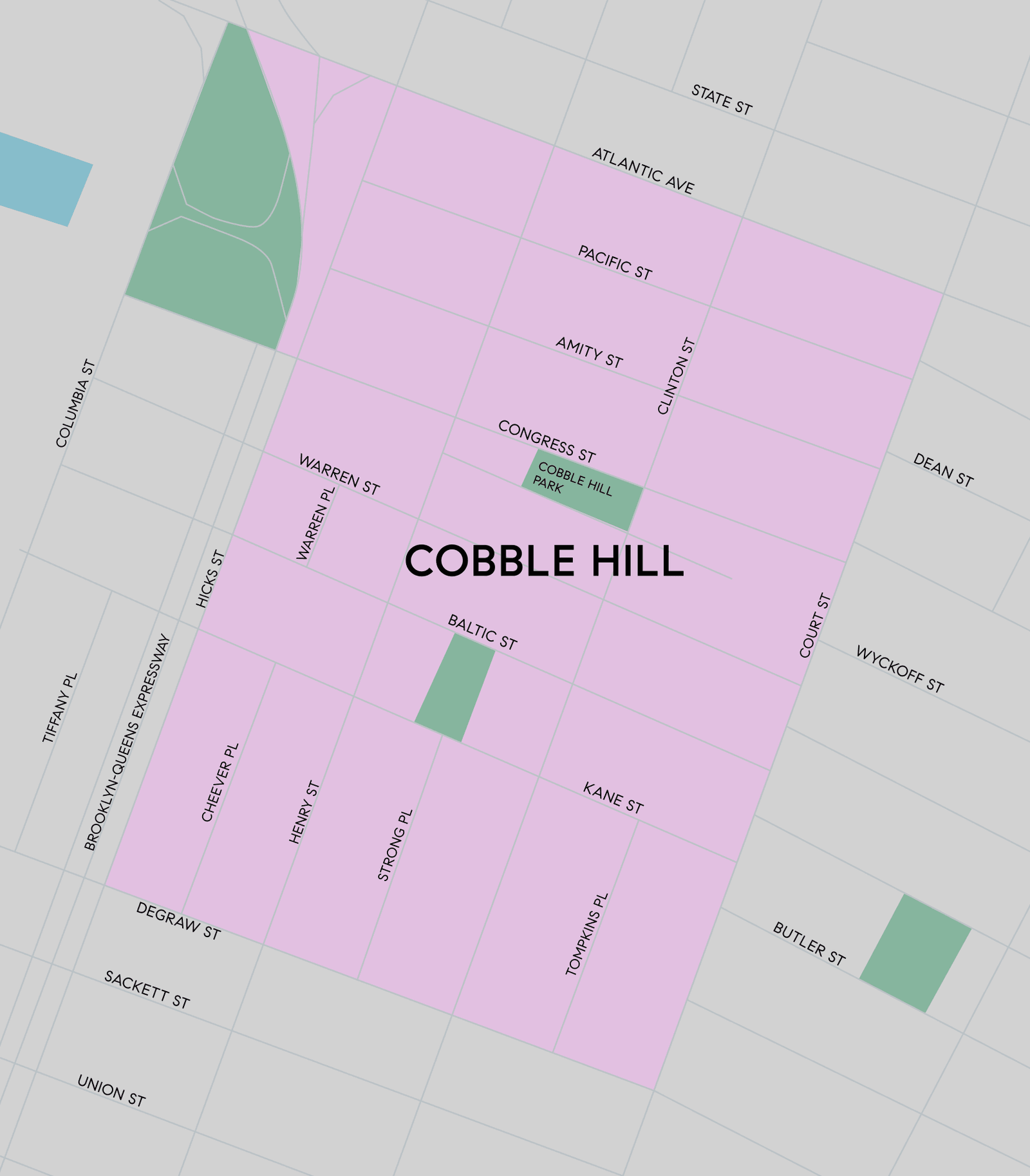
Cobble Hill sits south of Atlantic Avenue, bounded by the Brooklyn-Queens Expressway on the west, Court Street on the east, Degraw Street on the south, and Atlantic Avenue on the north. The area was Dutch farmland through the 17th and 18th centuries, then developed through the 1840s, ’50s, and ’60s as Brooklyn pushed south from the Heights. By 1969 the Landmarks Preservation Commission had designated the Cobble Hill Historic District — one of the earliest in NYC — extended in 1988, and listed on the National Register of Historic Places in 1976.
What makes Cobble Hill unusual is how completely the 19th-century streetscape survived. The architectural styles run from Greek Revival in the 1830s and 1840s through Gothic Revival, Italianate, and early Romanesque Revival in the 1850s and 1860s. Materials are brick and brownstone, in the masonry tradition. By published count, the Cobble Hill Historic District is one of the most intact 19th-century environments in the United States.
The neighborhood draws a specific buyer: people who want Brooklyn but with a quieter feel than the Heights and a smaller scale than Park Slope. Inventory is tightly held — many of these houses have been in the same families for decades, and a brownstone coming to market on Strong Place, Henry Street, or Verandah Place is a real event. Court Street is the commercial spine; Smith Street, one block east at the boundary with Boerum Hill, picks up the dining and shopping density.
Where Cobble Hill trades in 2026.
Data caveats worth knowing. Cobble Hill medians swing month-to-month because the neighborhood is small and a single Strong Place or Kane Street brownstone trade moves the number meaningfully. Co-op and condo medians sit in completely different ranges from brownstone medians — a $790K co-op closing and a $5M townhouse closing in the same month make the “median” almost meaningless without filtering by property type. Aspirational pricing pushes days on market past 100. For pricing decisions, comp at the property-type level within the same few blocks.
What’s actually for sale.
The prestige stock. Greek Revival, Italianate, neo-Grec, and early Romanesque Revival concentrated on Henry, Hicks, Strong Place, Tompkins, Cheever, Warren, and Verandah Place. Restored single-family configurations clear above $4M on the tighter blocks.
Pre-war and post-war stock; some converted from larger townhouses, others purpose-built. Typically the entry point into the neighborhood.
A smaller share, mostly conversions of brownstones into multi-unit boutique buildings. Newer condo construction is essentially absent inside the historic district.
A handful, very rarely available. When one comes up it usually trades through a brokered conversation, not a public listing.
What it’s like to live here.
Court Street.
Cobble Hill’s main commercial strip runs north-south, lined with restaurants, independent shops, and old-line family businesses. Court Pastry Shop, open since 1948, is one of the last family-owned Italian bakeries in the city — the rainbow cookies, cannolis, and sfogliatelle are made fresh daily. Cafe Luluc (cash only) draws weekend brunch lines. Books Are Magic, the independent bookstore, anchors the literary side. Henry Public is the burger; Karazishi Botan on Smith handles the ramen.
Atlantic Avenue.
The northern edge is where the older Lebanese-American merchant character is still strongest. Sahadi’s, the Middle Eastern grocer, is the institution — the hummus, olives, flatbread, spices, and olive oil have pulled Cobble Hill kitchens together for fifty-plus years. Shelsky’s of Brooklyn handles smoked fish and bagels. Chez Moi is the French place with the brunch that gets recommended.
Cobble Hill Park.
A small triangular park at Clinton and Verandah Place — quiet, tree-shaded, used for catching up, eating lunch, and watching kids. Brooklyn Bridge Park and the Brooklyn Bridge are within walking distance from most blocks in the neighborhood.
Transit.
Bergen Street and Carroll Street stations sit just east of Cobble Hill on the IND Culver Line, with the larger Borough Hall / Court Street complex reachable to the north at Atlantic. Lower and Midtown Manhattan run 20–25 minutes by subway from most of the neighborhood; Court Street and Smith Street are the walkable commercial spines, so day-to-day errands rarely require transit.
- Bergen Street — F G (between Cobble Hill and Boerum Hill, Smith Street)
- Carroll Street — F G (Carroll Gardens edge, Smith and Carroll)
- Borough Hall / Court Street complex — 2 3 4 5 R (north, at Atlantic)
- B57 bus on Court/Smith; B61 on lower Court
Schools.
Cobble Hill is in District 15.
- PS 29 John M. Harrigan (425 Henry Street) — the zoned public elementary, highly regarded, generally acknowledged as a top choice in the neighborhood. A 2022-23 rezoning is worth checking against any specific address.
- Cobble Hill School of American Studies — a small public secondary school in the neighborhood.
- Berkeley Carroll School — private K-12 just over in Park Slope; draws families from across western Brooklyn.
- Brooklyn Heights Montessori, Packer Collegiate, and Saint Ann’s — private options in walking distance via Brooklyn Heights.
Built 1830 to 1870. Landmarked 1969.
The 1969 Historic District designation (extended 1988) froze the visible streetscape. Inside, units have been renovated and re-renovated for sixty years — meaning the typical sale today is a building from the 1840s-1860s with a kitchen and mechanicals from the last decade. The styles run from Greek Revival on the older blocks through the dominant Italianate, with a smaller share of early Romanesque Revival rowhouses later in the period.
Practical notes for buyers
- Co-op boards in Cobble Hill are generally less strict than the Heights but still expect 20% down, post-closing liquidity, and a clean financial picture.
- Brownstone purchases need a deeper inspection than first-time buyers expect — foundation, roof, party-wall agreements with the neighbors, sometimes facade-restoration obligations. The 19th-century stock means original beam structures, joist sizes, and plumbing risers that don’t match modern code.
- The Historic District designation means exterior changes — windows, stoops, cornices, signage — go through the Landmarks Preservation Commission. It protects value; it also extends renovation timelines.
- Cobble Hill is geographically small — a five-minute walk from Atlantic to Degraw — so block-level differences matter a lot. Strong Place is not Kane Street; Cheever is not Verandah.
A block-by-block market.
Cobble Hill is one of the Brooklyn neighborhoods Tracie has worked since she started in NYC real estate in 1995. Her practice in the neighborhood has covered every property type it offers — Greek Revival and Italianate brownstones on Henry, Hicks, and Strong Place, condo conversions in the boutique buildings, the rare carriage house. The Tracie Approach mailers have covered Cobble Hill pricing patterns, the spread between brownstones and co-ops, and the way Cobble Hill trades against Brooklyn Heights and Carroll Gardens.
“Block-by-block matters more in Cobble Hill than buyers expect. A 22-foot wide on Strong Place is a different number than an 18-foot wide two blocks east, even with similar interior condition. The mechanics — pricing, the board package, the negotiation — are something I’ve seen across every kind of market cycle since the early 90s.”
If you’re thinking about buying or selling in Cobble Hill, the right starting move is a conversation about your specific building, your block, and your timing — not a generic walk-through.

Adjacent neighborhoods.
Cobble Hill, in plain answers.
What is the average home price in Cobble Hill?
The median sale price in Cobble Hill was about $3.0M as of March 2026 (up 46.2% year-over-year per Redfin), with the figure heavily weighted by recent brownstone sales. Filtered by property type: median condo at $1.2M, median co-op at $790K, and brownstones typically trading between $2.5M and $5M for restored single-family configurations. Because the neighborhood is small and inventory tight, look at recent comps within the same property type and the same few blocks — not the neighborhood average.
Is Cobble Hill a historic district?
Yes. The New York City Landmarks Preservation Commission designated the Cobble Hill Historic District on December 20, 1969, with an extension on June 7, 1988. The district was listed on the National Register of Historic Places in 1976 and is considered one of the most intact 19th-century environments in the United States. Exterior changes to landmarked buildings require LPC approval.
What are the best streets in Cobble Hill?
The most desirable residential blocks tend to be on Strong Place, Henry Street, Hicks Street, Tompkins Place, Cheever Place, Warren Street, Verandah Place, and the quieter sections of Kane and Baltic. Strong Place and Verandah Place — both short, narrow blocks — are particularly tightly held.
How are the schools in Cobble Hill?
The zoned public elementary is PS 29 John M. Harrigan at 425 Henry Street (District 15), highly regarded and generally considered a top choice in the neighborhood. A 2022-23 rezoning is worth confirming against specific addresses. Private options in walking distance include Berkeley Carroll (just south in Park Slope), and Brooklyn Heights Montessori, Packer Collegiate, and Saint Ann’s via the Heights.
What subway lines serve Cobble Hill?
Cobble Hill is served by the F and G trains at Bergen Street and Carroll Street, the two IND Culver Line stations on the Smith Street edge of the neighborhood. The 2, 3, 4, 5, and R at the Borough Hall / Court Street complex are reachable for residents near Atlantic Avenue. Most of Lower and Midtown Manhattan is 20–25 minutes by subway.
Are Cobble Hill brownstones a good investment?
Cobble Hill has held value through every NYC market cycle since the 1970s revival of the brownstone market. The Historic District designation, tight inventory, walkable commercial strips on Court and Smith, and adjacency to Brooklyn Heights and Brooklyn Bridge Park are all structural reasons demand stays steady. The 2025-26 data shows continued price appreciation, with the bigger question for any specific purchase being condition, lot width, and renovation history — not the neighborhood trajectory.
What's the typical board requirement for a Cobble Hill co-op?
Most pre-war and post-war co-op boards in Cobble Hill require 20% down minimum, post-closing liquidity of one to two years of carrying costs, and a clean financial picture. Boards here tend to be slightly less strict than Brooklyn Heights co-ops but stricter than Downtown Brooklyn condo boards. Prepare the package early.
Let’s talk about your building.
Tracie Golding — Compass · New York, NY. Selling Manhattan and Brooklyn since 1995.
Schedule a consultation