Brooklyn Heights
New York’s original suburb — a quiet bluff of 19th-century brownstones above the East River that became NYC’s first protected Historic District in 1965 and remains one of the most consistently desirable addresses in the city.
New York’s first Historic District, still intact.
Brooklyn Heights sits on a small bluff overlooking the East River, facing Lower Manhattan from across the water. The neighborhood was built up beginning in 1814, after Robert Fulton’s ferry made the trip to Wall Street routine. By the 1840s it was already considered fashionable; by the 1860s its brownstones were among the most desirable rowhouses in the country. Today the entire core — close to 600 buildings, 1820s through 1890s — is a federally and city-designated Historic District, the first in New York City.
What makes the neighborhood unusual is not the architecture itself (most of Manhattan once looked like this) but how completely it survived. Walking from Pierrepont Street down Willow to Cranberry, you pass Greek Revival rowhouses, Italianate brownstones, Second Empire facades with mansard roofs, and a scattering of pre-Civil-War wooden frame houses. More than 400 Greek Revival examples remain — work by Richard Upjohn and Minard Lafever among them. None of it is reproduction; all of it is in active use.
The neighborhood draws a specific buyer: people who value continuity and a quieter rhythm than Manhattan, who want a real piece of architecture rather than a new-construction unit, and who are willing to take on the realities of older buildings — board approvals, mechanical updates, the way pre-war floors move when the radiators come on. Trust-and-estates referrals, downsizers, and long-tenured families turn up here more than first-time buyers.
Where Brooklyn Heights trades in 2026.
Data caveats worth knowing. Brooklyn Heights medians swing month-to-month because the inventory is thin and a single brownstone trade can move the number meaningfully. PropertyShark reported a March 2026 median of $2.7M (+91.8% YoY) — that’s not a market shift, it’s two or three high-end brownstones closing in one month against a much smaller base of co-op trades. For pricing decisions, comps at the building level matter more than the neighborhood average. Brownstones in the prime row-house belt rarely list, and when they do they price aggressively. The highest recent recorded sale was 1 Sidney Place at approximately $22.1M in 2025.
What’s actually for sale.
The bulk of inventory — pre-war buildings on Hicks, Henry, Pierrepont, Montague, Remsen, and Joralemon. Strict boards; rich character. Typical full-floor or two-bedroom units with original moldings, sometimes original fireplaces; building rules vary widely.
The prestige stock. Greek Revival and Italianate rowhouses concentrated on Willow, Pierrepont, Sidney Place, and Remsen. Whole rowhouses trade roughly $10M–$12.5M; the condition spread is large and they rarely list.
A smaller share. New construction is essentially absent inside the Historic District, so most condos are conversions — 20 Henry Street among them — for buyers who want the location without co-op board scrutiny.
A handful, mostly on Hunts Lane and Grace Court Alley. Small, charming, and very rarely on the open market.
What it’s like to live here.
The Promenade.
The Brooklyn Heights Promenade — one-third of a mile of paved walkway from Remsen Street to Cranberry, cantilevered over the BQE — is the defining piece of public space. The Manhattan skyline view it offers is protected by the only Special Scenic District the city has ever designated (1974); no high-rise can be built between the Promenade and the water that would obstruct it. Residents treat it as a backyard.
Brooklyn Bridge Park.
Below the Promenade, Brooklyn Bridge Park stretches from Pier 1 down to Atlantic Avenue. Pier 6 has volleyball courts and gardens; Pilot, the oyster bar on a 1920s sailboat, is moored there in season. The park is the single biggest reason Brooklyn Heights now competes with the most expensive Manhattan neighborhoods for family buyers.
Dining & shops.
Montague Street is the high street — a working retail corridor more than a destination strip. Sahadi’s, the Lebanese grocer on Atlantic, is a Brooklyn Heights institution (the hummus is the local truth). L’Appartement 4F on Montague is the bakery line you’ll see most weekend mornings. Grimaldi’s and Brooklyn Ice Cream Factory anchor the DUMBO side, both walkable. Henry Street, Hicks, and Atlantic round out the day-to-day.
Transit.
Multiple lines converge here, which is half the reason buyers from Manhattan move over.
- Clark Street — 2 3 (Clark & Henry)
- Borough Hall / Court Street complex — 2 3 4 5 R (under Court, Joralemon, Montague)
- High Street — A C (Cadman Plaza)
- NYC Ferry from Pier 1 (Brooklyn Bridge Park) into Wall Street and Midtown
- Walking distance over the Brooklyn Bridge to Lower Manhattan (about 20 minutes)
Schools.
A strong zoned public option plus two long-established private schools inside the neighborhood.
- PS 8 Robert Fulton (37 Hicks Street) — the zoned public elementary/middle (K–8), District 13; ~584 students, strong recent test results; well regarded for its social studies curriculum.
- Packer Collegiate Institute (170 Joralemon Street) — private Pre-K–12, founded 1845, 5:1 student-teacher ratio.
- Saint Ann’s School — private, founded 1965 by Stanley Bosworth, K–12; progressive, no grades, with detailed individual narrative evaluations.
Built 1820 to 1890. Protected since 1965.
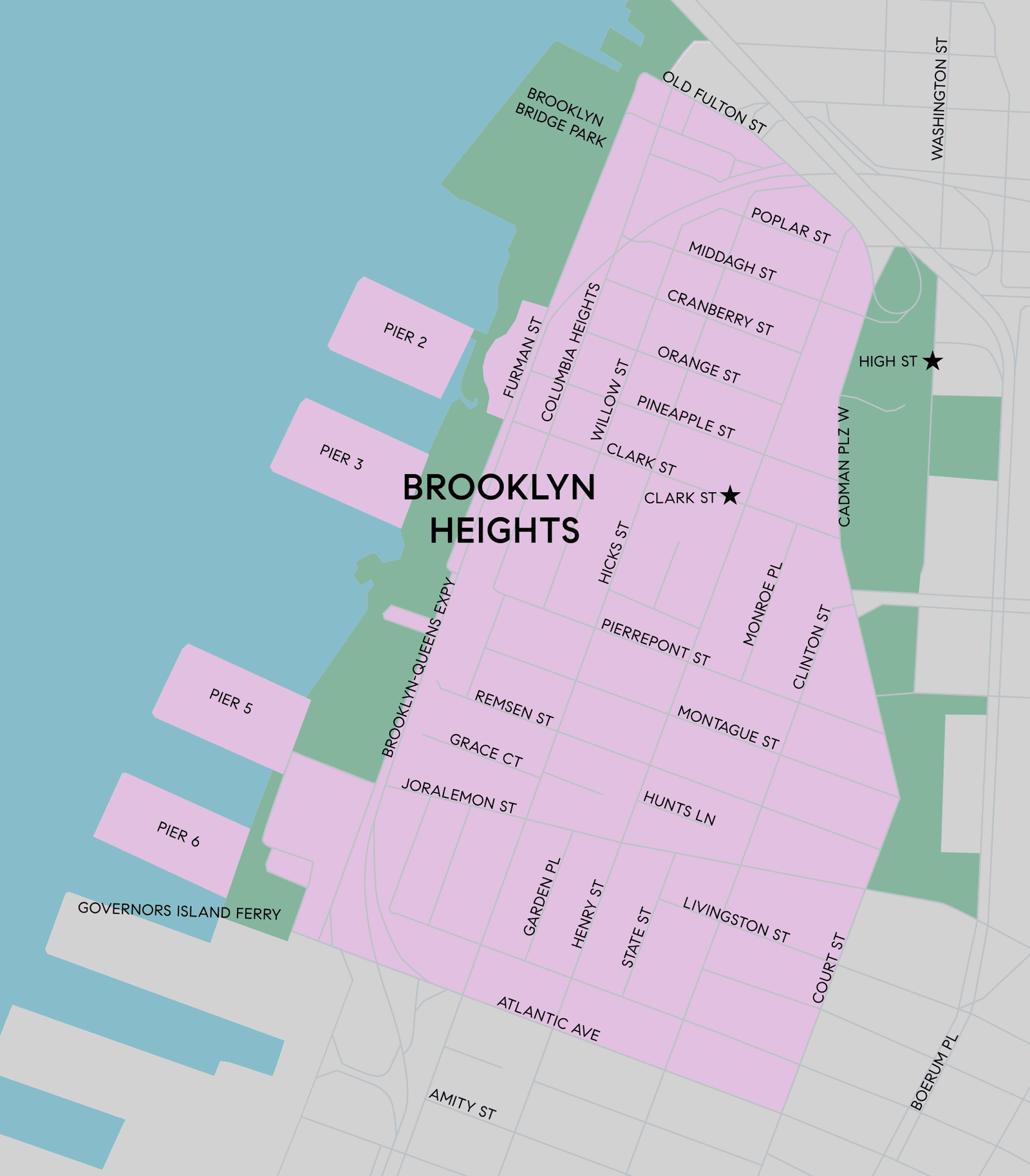
The Historic District designation in 1965 froze the visible streetscape. Inside any given pre-war building, however, units have been renovated and re-renovated continuously — meaning the typical sale today is a building from the 1840s with a kitchen from the 2010s. On the market you’ll find pre-war co-ops on Pierrepont, Remsen, Henry, Joralemon, Montague, and Hicks; Greek Revival rowhouses on Willow, Pierrepont, Sidney Place, and Grace Court; Italianate brownstones on State Street, Garden Place, and the southern blocks of Henry; rare carriage houses on Hunts Lane and Grace Court Alley; and a few condo conversions such as 20 Henry Street.
Practical notes for buyers
- Most co-op boards here are strict on liquidity, debt-to-income, and reserves. Plan for a 20–30% down minimum and post-closing liquidity of two to three years of carrying costs.
- Brownstone purchases usually involve a deeper engineering inspection than first-time buyers expect — foundation, roof, party-wall agreements with the neighbors, sometimes facade-restoration obligations.
- The Historic District designation means exterior changes (windows, stoop, cornice) go through the Landmarks Preservation Commission. It protects value; it also extends timelines.
- The Greek Revival and Italianate rowhouses span a wide condition range — original details and garden levels on one block, gut-renovated parlor floors on the next. Comps at the building and block level matter more than the neighborhood average.
No two listings are alike.
Brooklyn Heights is one of the neighborhoods Tracie has worked since she started in NYC real estate in 1995. Her practice in the Heights has covered every property type the neighborhood offers — pre-war co-ops on Pierrepont and Henry, Greek Revival brownstones on Willow and Sidney Place, condo conversions, the occasional carriage house. The Tracie Approach — her quarterly mailers — has covered Brooklyn Heights pricing, board-approval mechanics, and timing of sales repeatedly over the years.
“No two listings are alike. For sellers, creating the proper marketing approach — and adjusting it if the property doesn’t move — is the work. The mechanics — pricing, the board package, the negotiation — are something I’ve seen across every kind of market cycle since the early 90s.”
If you’re thinking about buying or selling in Brooklyn Heights, the right starting move is a conversation about your specific building, your block, and your timing — not a generic walk-through.

Adjacent neighborhoods.
Brooklyn Heights, in plain answers.
What is the average home price in Brooklyn Heights?
The median sale price in Brooklyn Heights ran around $1.4M as of April 2026 (up 36% year-over-year), with average sale prices closer to $1.7M and median listing prices near $2.3M. Whole brownstones routinely trade between $10M and $12.5M; the highest recent recorded sale was 1 Sidney Place at approximately $22.1M in 2025. Because inventory is thin, monthly medians swing on a few high-end trades — for pricing decisions, look at recent comparables within the same building or block, not the neighborhood average.
Is Brooklyn Heights a good neighborhood to live in?
Brooklyn Heights is consistently ranked among the most desirable neighborhoods in New York City, with quick subway access to Manhattan, the protected Promenade view, Brooklyn Bridge Park, top-rated public and private schools, and a low-rise residential character protected by NYC’s first Historic District designation (1965). It draws a buyer who values quiet, walkable streets, real architecture, and continuity over new construction.
What are the best streets in Brooklyn Heights?
The most desirable residential blocks tend to be on Pierrepont, Willow, Hicks, Henry, Remsen, Montague (between Henry and Hicks), Joralemon, and Sidney Place. The waterfront-adjacent blocks closest to the Promenade — from Remsen up to Cranberry — command the strongest pricing. Hunts Lane and Grace Court Alley offer rare carriage-house inventory but are tightly held.
How are the schools in Brooklyn Heights?
The zoned public elementary/middle school is PS 8 Robert Fulton in District 13 (37 Hicks Street, K-8), with strong recent test results. Major private options include Packer Collegiate Institute (Pre-K–12, founded 1845) at 170 Joralemon Street and Saint Ann’s School (K–12, founded 1965), both within the neighborhood.
What subway lines serve Brooklyn Heights?
Brooklyn Heights is served by the 2 and 3 trains at Clark Street; the 2, 3, 4, 5, and R trains at the Borough Hall / Court Street complex; and the A and C trains at High Street. NYC Ferry service runs from Pier 1 in Brooklyn Bridge Park to Wall Street and Midtown. The walk over the Brooklyn Bridge to Lower Manhattan is about 20 minutes.
Is Brooklyn Heights a historic district?
Yes — Brooklyn Heights was designated New York City’s first Historic District by the Landmarks Preservation Commission in 1965, protecting nearly 600 buildings spanning the 1820s through the 1890s. Exterior changes to landmarked buildings (windows, stoops, cornices, signage) require LPC approval. The Brooklyn Heights Promenade is additionally protected under the city’s only Special Scenic District (1974), which prevents any waterfront construction that would block the Manhattan-skyline view.
What are the typical board requirements for a Brooklyn Heights co-op?
Most pre-war co-op boards in Brooklyn Heights require 20–30% down minimum, post-closing liquidity of two to three years of carrying costs, strong debt-to-income ratios, and a full board package with references. Boards in the Heights are generally on the stricter end of NYC norms — plan accordingly and prepare the package early.
Let’s talk about your building.
Tracie Golding — Compass · New York, NY. Selling Manhattan and Brooklyn since 1995.
Schedule a consultation