DUMBO
Brooklyn's converted-warehouse waterfront — a few narrow cobblestone blocks under the Manhattan and Brooklyn bridges where 1880s–1930s industrial buildings became some of the most expensive loft and condo addresses in the borough.
Condos in 19th-century warehouses.
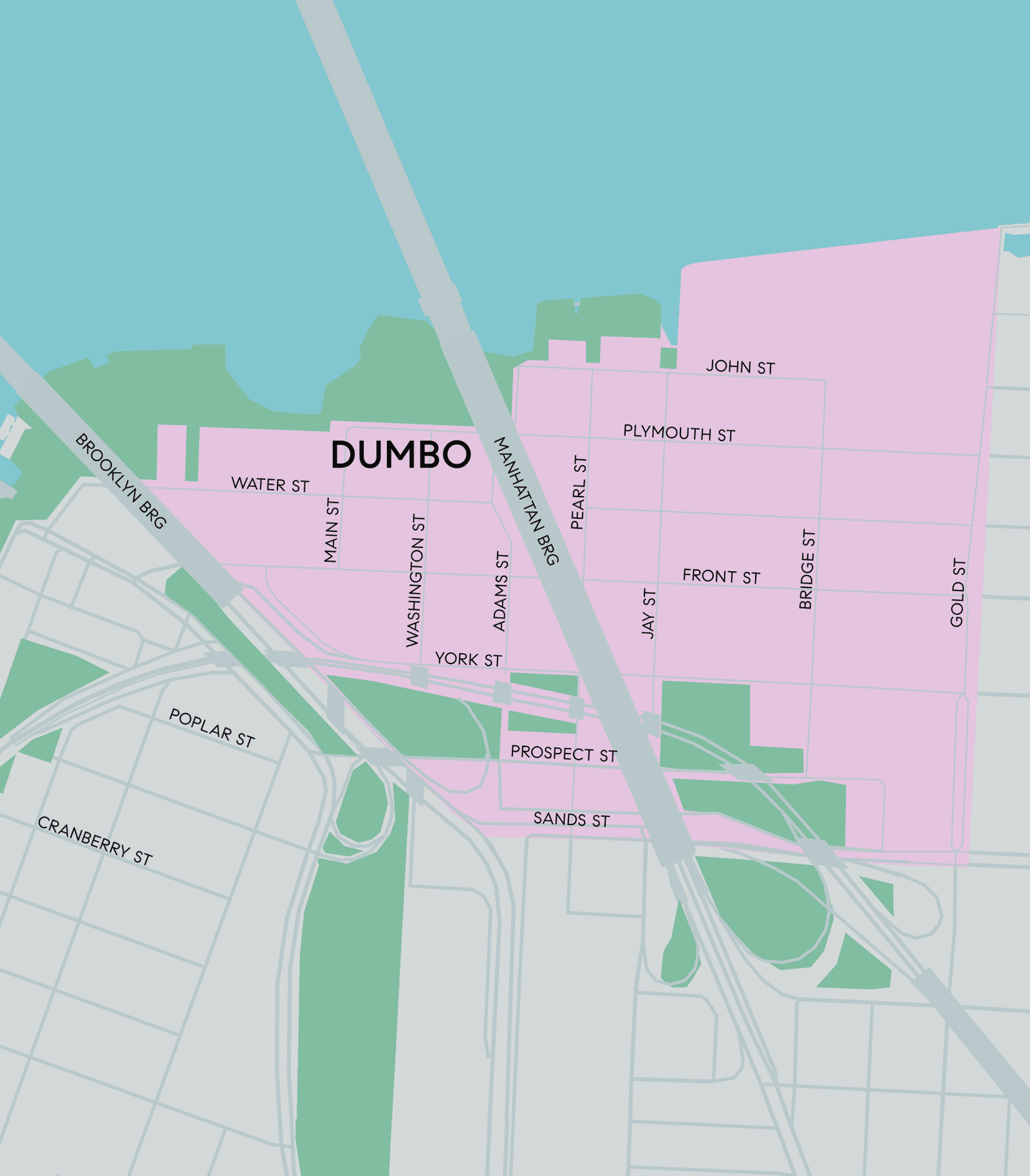
DUMBO — the acronym stuck in the late 1970s when artists started moving into vacant industrial space — sits Down Under the Manhattan Bridge Overpass on a small grid of streets pinned between the two bridges and the East River. Almost every building of consequence dates from between 1880 and 1930: paper factories, coffee warehouses, the Empire Stores complex that once held raw sugar and animal hides off the South American ships, the Eagle Warehouse (1893, Frank Freeman), and St. Ann's Warehouse, originally a Civil War-era tobacco inspection center. The Landmarks Preservation Commission designated the DUMBO Historic District in 2007, which froze the streetscape and set the rules for what conversions could and couldn't do to the facades.
What it actually feels like on the ground is a small neighborhood — Water Street, Front Street, Plymouth, Jay, Pearl, Washington, Main — with massive masonry loft buildings on every block, oversized industrial windows, exposed brick, and ferry traffic on the waterfront. Brooklyn Bridge Park runs along the entire western edge from Pier 1 down to Atlantic Avenue. Manhattan is twenty minutes by subway or one ferry ride, and that proximity is most of why DUMBO trades at the prices it does.
The buyer here is different from the buyer in Brooklyn Heights one block away. DUMBO draws people who want a loft — warehouse-conversion or new-construction — an open floor plan, river views, and a contemporary building rather than a pre-war co-op. The board-package culture is lighter; condos are 98% of the inventory. It is a neighborhood of condos in 19th-century buildings, and that contradiction is the whole point.
Where DUMBO trades in 2026.
Data caveats worth knowing. DUMBO is a small market with a wide spread — condos in the older converted lofts on Washington Street trade differently from the new glass towers on John Street or the Empire Stores units. Monthly medians can swing on one or two sponsor sales. The 220-day Redfin figure reflects that several aging high-end units have been listed and re-listed against newer comps; that doesn't describe the well-priced two-bedroom condo in a name-brand building, which often clears under 60 days. Look at recent comps in the specific building.
What’s actually for sale.
The historic core: 1 Main Street, 70 Washington, 30 Main, 145 Hudson, the Clocktower Building. Big open floor plans, original timber beams, oversized industrial windows. The pricing benchmark for the neighborhood.
Olympia Dumbo (30 Front Street), the Front & York development, J Condo, 1 John Street. Newer mechanicals, full amenity packages, river-facing glass. Premium pricing on the water-view lines.
The mixed-use conversion at Water Street and Old Dock, where S9 Architecture joined and added to the seven Civil War-era warehouses to create a retail, office, and food hub on the waterfront.
Most rentable lofts sit in the older converted industrial stock; a handful of true live/work artist lofts remain from the original 1970s wave but rarely come to market.
No brownstones, no rowhouses, and essentially no co-ops. The inventory is genuinely different from Brooklyn Heights and Cobble Hill next door — the industrial-era footprint produced a different kind of housing.
What it’s like to live here.
Brooklyn Bridge Park.
The park runs the length of the neighborhood. Pier 1 is the closest entrance from DUMBO; Jane's Carousel sits in its glass pavilion just below the Brooklyn Bridge; the lawn at Empire Fulton Ferry is the photo spot every visitor knows. Pebble Beach, the small cove between Jane's Carousel and the Brooklyn Bridge, is the closest thing residents have to a backyard. Summer movie nights on the Pier 1 lawn are the social calendar.
Dining & food.
Time Out Market at Empire Stores collects a rotating set of vendors under one roof. The River Café, on the water under the Brooklyn Bridge, is the dressed-up dinner. Cecconi's DUMBO and Celestine handle Mediterranean and Italian with bridge views. Juliana's and Grimaldi's are the two pizza institutions on Old Fulton Street that residents argue about. Luke's Lobster sits in the park, and Fontainhas on Jay Street is the all-day Goan cafe locals actually walk to.
Shops & culture.
Powerhouse Arena is the independent bookstore and event space on Water Street. St. Ann's Warehouse — the converted Tobacco Warehouse — is the resident theater. Independent boutiques and design studios cluster on Water and Front Streets. The art-gallery presence from the 1970s–90s artist era has thinned, but DUMBO Open Studios still happens annually.
Transit.
This is the one structural compromise of the neighborhood. The only station inside DUMBO is deep, single-entrance, and not ADA-accessible, so the ferry and the backup stations at the edges matter.
- York Street — F (only station inside DUMBO; one entrance, deep, not ADA-accessible)
- High Street — A C (walkable backup at the Brooklyn Heights edge)
- Jay Street–MetroTech — A C F R (longer walk south, ADA-accessible)
- NYC Ferry — Pier 1 to Wall Street, Midtown, Long Island City, and Williamsburg
- Bike — protected lanes along Plymouth and through the park, plus Citi Bike stations on every other block
Schools.
DUMBO sits in District 13. Zoning lines here have been revisited multiple times, so confirm the current boundary at the specific address.
- PS 8 Robert Fulton (37 Hicks Street) — historically zoned for parts of DUMBO; A-rated, top 6% of NYC elementaries
- PS 307 Daniel Hale Williams — zone expanded in 2016 to include DUMBO and ease overcrowding at PS 8
- The Dock Street School for STEAM Studies — middle school (6–8), well regarded
- Imagine Dumbo - Adams (85 Adams Street) — 3K and Pre-K
Built 1880 to 1930. Frozen 2007.
The Historic District designation in 2007 covers the converted industrial core; almost all of those buildings are between 1880 and 1930 and protected at the facade level. Inside, the typical sale is a 19th-century warehouse with a 2010s or 2020s kitchen and a full mechanical re-do. Loft condos bring large open floor plans, 12–14 foot ceilings, original timber beams and cast-iron columns, and oversized arched or rectangular windows — the defining DUMBO product. The new-construction towers (Olympia, Front & York, J Condo, 1 John Street) add full amenity packages and contemporary mechanicals. The $10M+ comps live in the penthouse and triplex stock at 1 Main Street, Front & York, and a few newer towers; the recent $16.25M sponsor sale set the current ceiling.
Practical notes for buyers
- Most boards here are condo boards rather than co-op boards — lower scrutiny, faster approval, easier financing. That's part of why prices clear above comparable square footage in Brooklyn Heights co-ops.
- Condo common charges run high — newer amenity buildings often $2–3+/sq ft monthly in common charges alone, before tax abatements expire.
- Look closely at any 421-a tax abatement timing. Several DUMBO new-construction buildings have abatements expiring within 5–10 years; that meaningfully changes total carrying cost.
- The Landmarks designation matters for any exterior modification — windows, signage, terraces — same LPC process as any other historic district.
- Subway access is the single biggest practical compromise. Make sure your commute math works against York Street's actual reliability.
A building-by-building market.
DUMBO is one of the Brooklyn neighborhoods Tracie has worked since she started in NYC real estate in 1995. Her practice here has covered loft condos in the historic conversions on Water and Washington Streets, new-construction units in the towers along the waterfront, and the occasional artist-era live/work loft when one of those rare ones surfaces. The work runs to the mechanics — the spread between warehouse-conversion and new-construction, the impact of the 421-a expirations, and the way the neighborhood trades against Brooklyn Heights across the bridge.
“No two listings are alike. In DUMBO especially — a loft in 1 Main is a different conversation than a unit in Front & York, even at the same price per foot. The mechanics — pricing, the building's financials, the abatement schedule — are something I've seen across every kind of market cycle since the early 90s.”
If you’re thinking about buying or selling in DUMBO, the right starting move is a conversation about your specific building, your block, and your timing — not a generic walk-through.

Adjacent neighborhoods.
DUMBO, in plain answers.
What is the average home price in DUMBO?
The median sale price in DUMBO was approximately $2.2M for Q1 2026 (up about 6% year-over-year per PropertyShark), with the median condo price reaching $2.495M in August 2025 and median asking prices around $1.92M at $1,626/sq ft in April 2026. Waterfront condos in the converted warehouses and new towers regularly trade above $1,200/sq ft; the most recent record sale was a sponsor penthouse at $16.25M. Because DUMBO is a small market with both warehouse-conversion and new-construction stock at different price points, look at recent comps within the specific building rather than the neighborhood average.
What kind of homes are in DUMBO?
DUMBO is approximately 98% condos. The inventory splits into two main categories: loft conversions of 1880–1930 industrial buildings (think 1 Main Street, 70 Washington, the Clocktower) and new-construction condo towers (Olympia, Front & York, J Condo, 1 John Street). There are essentially no brownstones, no co-ops, and almost no rowhouses inside DUMBO — the neighborhood's industrial-era footprint produced a different kind of housing than the brownstone neighborhoods south and east of it.
Is DUMBO a historic district?
Yes. The Landmarks Preservation Commission designated the DUMBO Historic District in 2007, protecting the core warehouse and loft buildings from the 1880–1930 industrial era. Exterior changes go through LPC review. Empire Stores, Eagle Warehouse, St. Ann's Warehouse, and the converted lofts on Water, Front, Washington, and Plymouth Streets fall inside the district.
What subway lines serve DUMBO?
DUMBO is served primarily by the F train at York Street — the only station inside the neighborhood and a known infrastructure issue (one entrance, deep, no ADA access). The A and C trains at High Street and the A, C, F, and R trains at Jay Street–MetroTech serve as walkable backups. NYC Ferry runs from Pier 1 in Brooklyn Bridge Park to Wall Street, Midtown, Long Island City, and Williamsburg.
How are the schools in DUMBO?
DUMBO sits in District 13. PS 8 Robert Fulton (K–8) historically zoned much of DUMBO and is A-rated, top 6% of NYC elementaries; PS 307 Daniel Hale Williams was rezoned to include parts of DUMBO in 2016 to ease overcrowding. The Dock Street School (6–8) and Imagine Dumbo - Adams (3K/Pre-K) round out the in-neighborhood public options. Confirm the current zoning at the specific address — District 13 lines have been revisited multiple times.
What's the difference between a DUMBO loft and a Brooklyn Heights co-op?
Most DUMBO units are condos in 19th-century warehouse conversions or new high-rise buildings — open plans, big industrial windows, fewer board restrictions, lighter financial scrutiny. Brooklyn Heights is mostly pre-war co-ops with strict boards, 20–30% down minimums, and conservative debt-to-income requirements. The two neighborhoods are five minutes apart on foot but represent two completely different ways of owning property in NYC.
Is DUMBO a good investment?
DUMBO has appreciated steadily since the early 2010s and the median sale price was up about 6% YoY in Q1 2026. The current 10-month supply puts it slightly into buyer's-market territory by Brooklyn standards, and several new towers are bringing inventory online through 2026. The most important question for any individual purchase is the building's financials and any tax-abatement schedule — those drive total cost of ownership far more than the neighborhood headline number.
Let’s talk about your building.
Tracie Golding — Compass · New York, NY. Selling Manhattan and Brooklyn since 1995.
Schedule a consultation