Flatiron
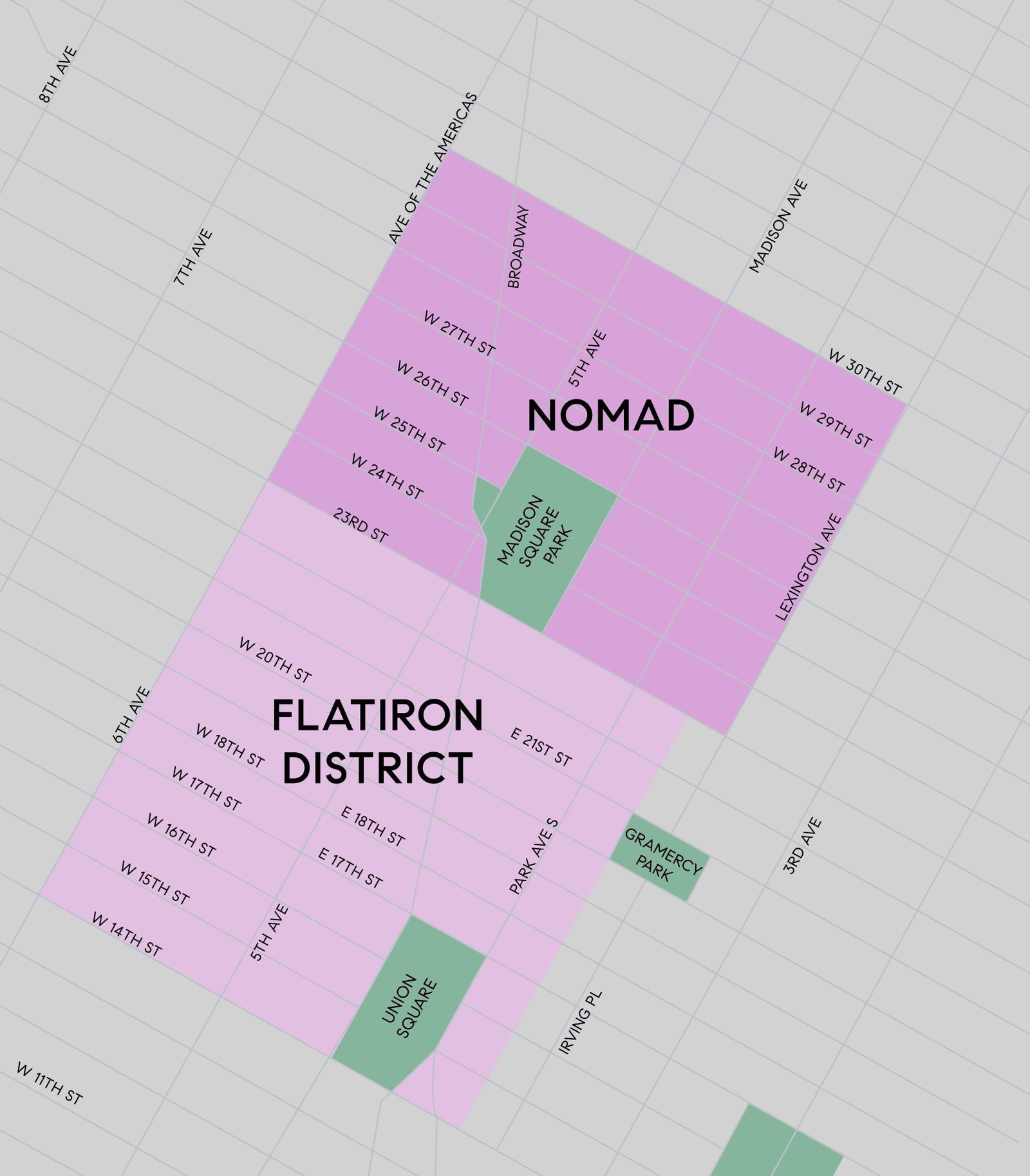
The pre-war loft pocket framed by 14th Street, 23rd Street, Park Avenue South, and Sixth Avenue — defined by Daniel Burnham's 1902 building at the wedge of Fifth and Broadway, and by a residential stock dominated by loft conversions and pre-war condos.
A Ladies' Mile shopping corridor that became loft housing.
The Flatiron District sits between 14th and 23rd Streets, framed by Park Avenue South to the east and Sixth Avenue to the west. The neighborhood takes its name and its identity from the Flatiron Building at 175 Fifth Avenue — Daniel Burnham's 1902 wedge-shaped 22-story Beaux-Arts tower built into the triangular lot where Broadway crosses Fifth at 23rd Street. The building was a NYC landmark in 1966 and a National Historic Landmark by 1989.
In the late 19th century this was Ladies' Mile — the city's premier shopping corridor, lined with department-store palazzos on Sixth Avenue and on Broadway. The Ladies' Mile Historic District (designated 1989) protects 440 buildings across the area, including a remarkable run of cast-iron commercial architecture. After the department stores moved north in the early 1900s, the buildings stayed; many were repurposed as showrooms, manufacturing, and (later) loft-style office and residential space.
The current residential character emerged in the 1990s and 2000s, when the larger pre-war commercial buildings were converted to condos and co-ops. The recent conversion of the Flatiron Building itself into 60 condos — priced from roughly $10.95M, with Unit 8-North at 175 Fifth recording Manhattan's top contract in May 2026 at about $18M — reset the per-foot benchmark for the neighborhood. The buyer Flatiron draws is specific: people who want loft proportions inside a real pre-war commercial conversion, who care about ceiling height and Fifth Avenue addresses, and who appreciate the density of restaurants, parks, and subway access at 23rd and Madison Square.
Where Flatiron trades in 2026.
Data caveats worth knowing. Flatiron is one of the more sample-sensitive medians in Manhattan because the residential trading pool is small and the price band is wide — a single Flatiron Building closing can pull the monthly median up by hundreds of thousands. The simultaneous “down 23% YoY” in median sale price and “up 14.6% YoY” in co-op median illustrates the gap: condos cooled on more inventory, co-ops held. Days-on-market in the 100+ range means realistic pricing matters; the aggressive 2021–2022 pricing tactics don't work here today.
What’s actually for sale.
The defining inventory. Larger commercial buildings on Broadway, Fifth, Park Avenue South, and the cross streets between 18th and 23rd converted to residential. Typical 11–14 foot ceilings, oversized windows, column-and-beam structure.
Fewer in number than the West Village or Upper East Side but present in scale: buildings on Fifth, Broadway, and East 16th–22nd. Stricter board approval, more conservative buyers.
The 175 Fifth Avenue Flatiron Building conversion sets the high end; other trophy condos run along Fifth and 26th. Full amenity packages and easier financing than the loft stock.
A small share, limited inside the Ladies' Mile Historic District. What exists is concentrated on the edges — Park Avenue South and the 14th Street corridor.
What it’s like to live here.
Madison Square Park.
The northern anchor of the neighborhood. Six acres, mature trees, the Madison Square Park Conservancy's rotating contemporary public-art installations, the original Shake Shack at the southeast corner. Daniel Burnham's Flatiron Building closes the southern end of the park; the Met Life Tower (1909) closes the eastern.
Eataly NYC Flatiron.
Forty-two thousand square feet of Italian food market and restaurants at 200 Fifth Avenue (corner of 23rd), opened 2010 — the anchor of the neighborhood's food retail. Serra by Birreria, the rooftop, runs seasonal themed installations through the year.
Dining.
Gramercy Tavern (42 East 20th Street) — Danny Meyer's 1994 New American institution — still books two to three weeks ahead. Cote on West 22nd is the only Michelin-starred Korean steakhouse in the city. Rezdôra (Emilia Romagna pastas), COQODAQ (upscale Korean fried chicken), BLACKBARN, Casa Carmen, Boqueria, Toro, and ABC Kitchen fill out a dining density per block that is among the highest in Manhattan.
Shopping & culture.
Rizzoli Bookstore (1133 Broadway, in the St. James Building) is the indie literary anchor. Fishs Eddy, ABC Carpet & Home (881 Broadway), and Restoration Hardware's Madison Square flagship in the 1893 Stewart's Cast Iron Palazzo round out the retail. The 230 Fifth rooftop is the long-standing skyline bar.
Transit.
Dense and redundant — many addresses can reach 6+ subway lines within a 5–7 minute walk.
- 23rd Street — 6 at Park Avenue South; R, W at Broadway; F, M at Sixth Avenue
- 14th Street–Union Square (4–5 blocks south) — 4 5 6 L N Q R W, one of the city's largest interchanges
- 28th Street — 6 at Park; R, W at Broadway
- Express bus and crosstown bus service on 23rd
Schools.
Both closest public elementaries sit just over the neighborhood line and perform above NYC averages; the private options within walking distance run deep.
- PS 11 William T. Harris (320 West 21st Street, just over the West Chelsea line) — public elementary, District 2, ~739 students, ~14:1 ratio, well regarded
- PS 40 Augustus St.-Gaudens (320 East 20th Street, just east in Gramercy) — public elementary, District 2, performing above NYC average
- Friends Seminary (222 East 16th Street, Stuyvesant Square) — Quaker independent K-12, founded 1786, one of the oldest schools in NYC
- Léman Manhattan (Pre-K–12) and other District 2 private options within walking distance
Ladies' Mile, designated 1989. Flatiron Building, 1902.
The Ladies' Mile Historic District (designated 1989) covers 440 buildings across roughly 28 blocks, including most of the cast-iron commercial palazzos along Broadway and Sixth Avenue between 14th and 24th Streets. The Flatiron Building (1902) was individually landmarked in 1966 and named a National Historic Landmark in 1989. The Madison Square North Historic District (2001) protects the area immediately north and east of Madison Square Park. What you'll find on the market: loft conversions in former department-store and showroom buildings, pre-war co-ops, the Flatiron Building condo conversion, boutique conversion condos on East 19th–22nd, and limited newer construction on the edges.
Practical notes for buyers
- Loft conversions vary widely on what's allowed. Some are J-51 or 421-a–era conversions with specific tax abatement schedules — check when the abatement burns off and what the unabated maintenance / common-charge bill looks like.
- The Ladies' Mile and Madison Square North Historic District designations mean exterior changes — windows, signage, storefronts — go through the Landmarks Preservation Commission. It protects value; it extends renovation timelines.
- Many pre-war condo and co-op buildings here carry meaningful capital reserves and active facade restoration cycles. Ask for three years of board minutes.
- Per-foot pricing inside the Flatiron Building sets a new high benchmark, but the building's distinctive shape means floor plans are unconventional. A unit's value depends heavily on which side of the wedge it sits on.
Two markets, not one.
The Flatiron District is one of the Manhattan markets Tracie has worked since she started in NYC real estate in 1995. Her practice in the neighborhood has covered the range — pre-war loft conversions on Broadway and Fifth, pre-war co-ops on the cross streets between Park and Fifth, the more recent condo conversions along the Ladies' Mile spine. The Tracie Approach — her quarterly mailers — has covered Flatiron pricing and the mechanics of buying inside a loft conversion repeatedly over the years.
“Flatiron is two markets, not one. The pre-war loft conversions trade on ceiling height, light, and the address. The newer condo product trades on amenities and the building's reputation. Pricing them against each other on a per-foot basis misses the point.”
If you’re thinking about buying or selling in Flatiron, the right starting move is a conversation about your specific building, your block, and your timing — not a generic walk-through.

Adjacent neighborhoods.
Flatiron, in plain answers.
What is the average home price in the Flatiron District?
The median sale price in the Flatiron District was approximately $2.3M (down 23.2% YoY on a small sample), with median price per square foot near $1,420. Median condo prices in November 2025 sat around $2.0M (down 21.9% YoY), while median co-op prices were $1.7M (+14.6% YoY). The recent Flatiron Building (175 Fifth Avenue) condo conversion sets a high-end benchmark, with entry pricing from roughly $10.95M and a Unit 8-North contract at approximately $18M (May 2026 — Manhattan's top contract that week). Because the trading pool is small, monthly medians swing on a few high-end trades.
Is the Flatiron District a good neighborhood to live in?
The Flatiron District is one of Manhattan's most consistently desirable downtown neighborhoods, with the original Madison Square Park at its center, the Flatiron Building (1902) and Met Life Tower (1909) anchoring the skyline, dense subway access at 23rd (6 / R / W / F / M) and the 14th Street–Union Square mega-hub four blocks south, Eataly and Gramercy Tavern at the food infrastructure level, and a Walk Score in the high 90s. It draws buyers who want loft proportions inside pre-war buildings, in walking distance of every kind of subway line.
What are the best streets and buildings in the Flatiron District?
The most desirable buildings include the Flatiron Building itself (175 Fifth Avenue), the trophy pre-war condos along Fifth and Madison around the park, and the loft conversions on Broadway and Park Avenue South between 17th and 22nd. The cross streets between Park and Fifth in the East 19th–22nd range tend to carry the strongest residential character. Direct frontage on Madison Square Park is the highest pricing band.
How are the schools in the Flatiron District?
The closest public elementary schools are PS 11 William T. Harris (320 West 21st Street, just west) and PS 40 Augustus St.-Gaudens (320 East 20th Street, just east in Gramercy) — both District 2, both performing above NYC averages. Private options within walking distance include Friends Seminary (222 East 16th Street, K-12, founded 1786) and Léman Manhattan, plus the broader downtown private network.
What subway lines serve the Flatiron District?
The Flatiron District is served by the 6 at 23rd Street and Park Avenue South; the R and W at 23rd and Broadway; the F and M at 23rd and Sixth Avenue; the 6 and R/W at 28th Street; and the 14th Street–Union Square mega-hub (4, 5, 6, L, N, Q, R, W) is a 4–5 block walk south. Most addresses can reach 6+ subway lines within a 5–7 minute walk.
Is the Flatiron District a historic district?
Most of the Flatiron District is protected under either the Ladies' Mile Historic District (designated 1989, 440 buildings across 28 blocks) or the Madison Square North Historic District (designated 2001). The Flatiron Building itself was designated an individual NYC landmark in 1966 and a National Historic Landmark in 1989. Exterior changes — windows, signage, storefronts, cornices — require LPC approval.
What's the difference between a Flatiron loft and a Flatiron condo?
Most “lofts” in the Flatiron District are units inside condo or co-op buildings — the term refers to the layout (open plan, 11–14 foot ceilings, column-and-beam structure) inside a pre-war commercial conversion. A “Flatiron condo” in newer construction will have a more conventional apartment layout, full amenity packages, and easier financing. Per-foot pricing on lofts trades on ceiling height, light, and column placement; newer condos trade on amenity tier and address.
Let’s talk about your building.
Tracie Golding — Compass · New York, NY. Selling Manhattan and Brooklyn since 1995.
Schedule a consultation