Greenwich Village
The Washington Square Park and NYU half of the Village — Federal and Greek Revival townhouses around the park, pre-war co-op buildings stepping up Fifth Avenue, and one of the largest contiguous Historic Districts in New York City.
Building stock that can’t expand.
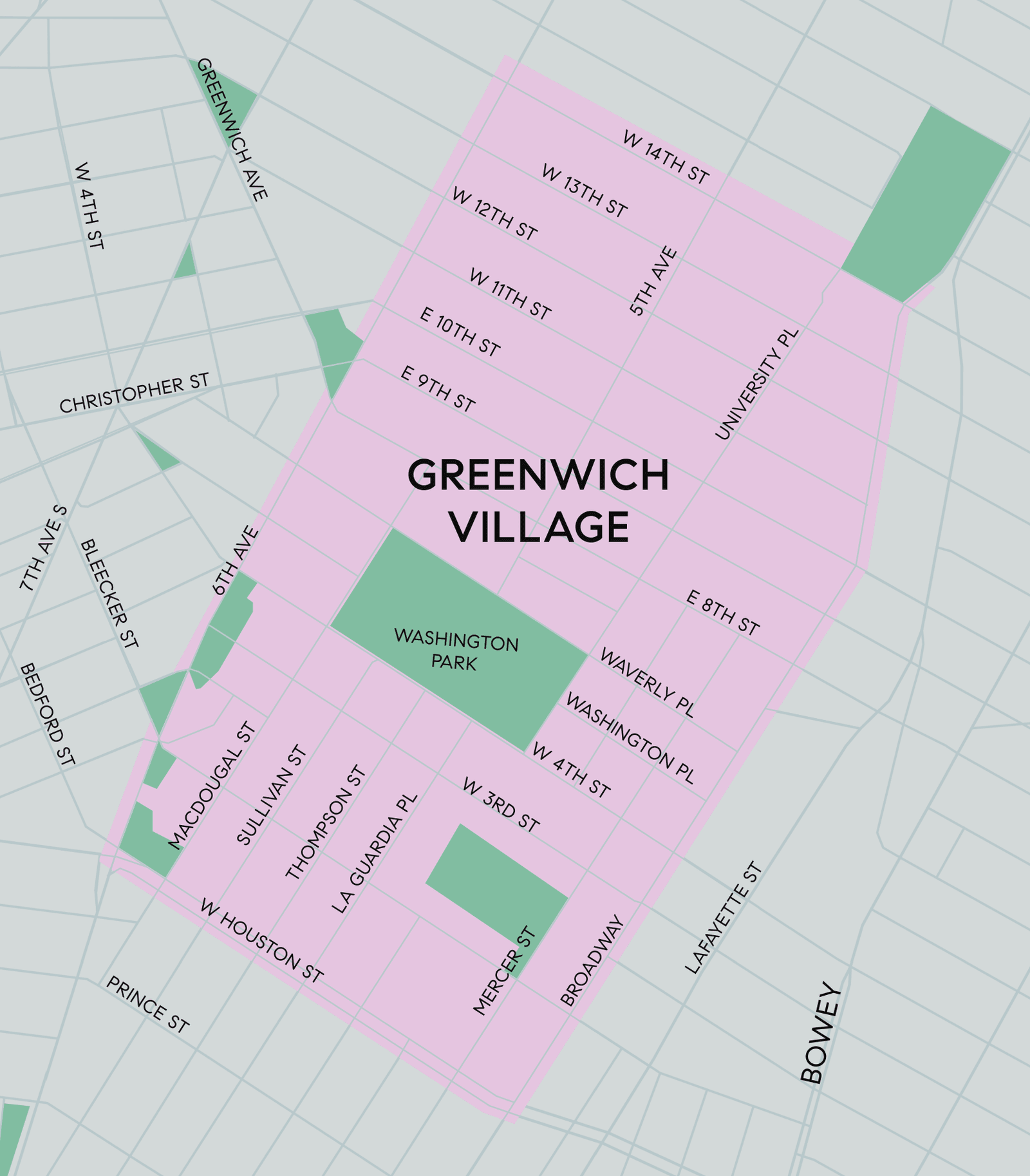
Greenwich Village runs roughly from Sixth Avenue east to Broadway, and from 14th Street south to Houston. Washington Square Park sits at the center, NYU surrounds it on three sides, and the streets — Bleecker, MacDougal, Sullivan, Thompson, LaGuardia — predate the Commissioners’ Plan of 1811 and bend off the grid accordingly. The park itself was a potter’s field from 1797 to 1823; by 1832, the Greek Revival rowhouses on the north side of Washington Square — “The Row” on Washington Square North — were going up, and lower Fifth Avenue began to establish itself as a fashionable address.
The 20th century turned the Village into the country’s reference point for bohemia — the Beats at the Cedar Tavern, jazz at the Village Vanguard and the Blue Note, Dylan in MacDougal Street basements, the modern LGBTQ movement crystallizing around Christopher Street. Most of that history still has a physical address. The Washington Square Arch (Stanford White, 1892) was where six artists led by Marcel Duchamp climbed up one night in 1916 and declared the Village a “Free and Independent Republic.”
The Greenwich Village Historic District (1969) protects more than 2,000 buildings across roughly 100 blocks, including most of the neighborhood east of Sixth Avenue. Building stock can’t expand. The same townhouse blocks, the same pre-war co-op buildings, the same NYU-adjacent buildings — that’s the inventory.
Where Greenwich Village trades in 2026.
Data caveats worth knowing. Greenwich Village medians move a lot because the trading pool is small and the dollar range is wide — a few high-end condo trades pushed the February 2026 condo median above $4.9M (up over 100% YoY), which is a sample-size artifact, not a market shift. The numbers that hold up across sources: per-foot pricing of ~$1,490 (+5.7% YoY), co-op medians around $1.1M, and steady but unhurried days-on-market in the 60–70 range.
What’s actually for sale.
The prestige stock. “The Row” on Washington Square North; rowhouses on West 9th, West 10th, West 11th, MacDougal, Sullivan.
Taller (10–18 story) buildings on Fifth between 8th and 14th. Strict boards; established staff.
On University Place, Waverly, Washington Place, MacDougal, Sullivan; mid-rise, often four to twelve units.
A smaller share than co-ops. Newer construction concentrated on University, near Astor Place, and in former NYU-adjacent commercial conversions.
Washington Mews, MacDougal Alley, Patchin Place. Very rarely available.
What it’s like to live here.
Washington Square Park.
The park is the center of gravity. The arch, the fountain (a meeting point since the 1870s), the chess tables at the southwest corner, the dog runs, the steady rotation of musicians, students, and dosa-cart lunches. The Saturday afternoon outdoor concerts and the chess hustlers have been there for decades. Kandaswamy Thirukumar’s NY Dosas cart, run from the southwest corner of the park since 1991, is the most consistent piece of street food in Lower Manhattan.
Dining.
Minetta Tavern (1937) on MacDougal — Hemingway and E.E. Cummings were regulars; the Black Label Burger still books out two weeks ahead. Carbone on Thompson — the Major Food Group spicy-rigatoni reservation that defined the 2010s. Via Carota, Sant Ambroeus on West 4th, Dame on MacDougal, Buvette across the avenue. Bleecker between Sixth and LaGuardia carries the working specialty food row — Murray’s Cheese, Ottomanelli & Sons, Faicco’s Italian Specialties, Porto Rico Importing.
Culture.
Blue Note on West 3rd and Village Vanguard on Seventh Avenue South are two of the most consequential jazz rooms in the country. IFC Center (Sixth and 3rd) screens independent film. The Public Theater is a short walk east at Astor Place. NYU’s footprint touches almost every block.
Transit.
Greenwich Village sits on top of one of the largest subway interchanges in the city. The neighborhood proper is small and walkable; the deeper side streets (MacDougal, Sullivan, Thompson) are quieter than the avenues.
- West 4th Street–Washington Square — A B C D E F M (the entire IND Eighth Avenue / Sixth Avenue stack)
- 8th Street–NYU — R W
- Astor Place — 6
- 14th Street–Union Square (a few blocks north) — 4 5 6 L N Q R W
- Christopher Street PATH — across Sixth, into Hoboken / Newark
Schools.
The Village has one of the strongest public elementaries in Manhattan plus a deep bench of independent options.
- PS 41 Greenwich Village (116 West 11th Street) — the zoned public elementary, PK-5, District 2. National Blue Ribbon (2021), ~476 students; strong recent test results.
- PS 3 Charrette School (490 Hudson Street, just over the West Village line) — alternative progressive K-5.
- Little Red School House & Elisabeth Irwin (LREI) (272 Sixth Avenue) — independent progressive PK-12, founded 1921 by Elisabeth Irwin; one of NYC’s first progressive schools.
- Grace Church School (86 Fourth Avenue) — independent K-12.
Built before the Civil War. Frozen 1969.
The Greenwich Village Historic District (1969) — one of the largest single landmark designations the NYC Landmarks Preservation Commission has ever made — protects the visible streetscape of essentially the entire neighborhood east of Sixth Avenue. The Federal-style rowhouses (1790–1830) on MacDougal-Sullivan, the Greek Revival “Row” on Washington Square North (1832), and the Italianate brownstones up Fifth Avenue all date from before the Civil War. What you’ll find on the market: Federal-style brick rowhouses with dormer roofs and fanlight transoms; Greek Revival rowhouses on “The Row,” West 9th, West 10th, and West 11th; Italianate brownstones on lower Fifth Avenue; pre-war co-op buildings (1 Fifth, 2 Fifth, 24 Fifth, 25 Fifth, 50 Fifth); smaller pre-war walk-ups; and a smaller stock of new and converted condos near Astor Place and on University Place.
Practical notes for buyers
- Lower Fifth Avenue co-op boards run on the stricter end of NYC norms — plan for 20–30% down minimum, post-closing liquidity of two to three years of carrying costs, and a full board package with references.
- Townhouse purchases involve a deeper engineering inspection than first-time buyers expect — Federal-era foundations, party-wall agreements, roof, sometimes facade-restoration obligations under LPC.
- The Historic District designation means exterior changes (windows, stoops, cornices) go through LPC. It protects value; it extends renovation timelines.
- Per-foot pricing is wide. Same block, two listings: a renovated lower Fifth Avenue co-op at $2,000+/ft, a tired walk-up at $1,200/ft. Comp at the building level.
A building-by-building market.
Greenwich Village is one of the Manhattan markets Tracie has worked since she started in NYC real estate in 1995. Her practice in the neighborhood has covered the range of property the area offers — Federal and Greek Revival townhouses around Washington Square, pre-war co-ops up Fifth Avenue, walk-ups on MacDougal and Sullivan. The Tracie Approach — her quarterly mailers — has covered Village pricing and board-approval mechanics repeatedly over the years.
“Lower Fifth Avenue is one of the most consistent buildings-by-buildings markets in Manhattan. Same block, four pre-war co-op buildings, four different boards, four different price-per-foot expectations. You can’t comp this neighborhood with a borough average.”
If you’re thinking about buying or selling in Greenwich Village, the right starting move is a conversation about your specific building, your block, and your timing — not a generic walk-through.

Adjacent neighborhoods.
Greenwich Village, in plain answers.
What is the average home price in Greenwich Village?
The median sale price in Greenwich Village was approximately $1.5M in early 2026, up 18.9% year-over-year, with a median price per square foot of $1,490. Co-op medians sat near $1.1M (+12.8% YoY); the February 2026 condo median of $4.9M reflects a thin sample of high-end trades rather than a 100%+ market shift. Townhouses typically trade $5M–$36M+ depending on width and condition. Because the trading pool is small, look at recent comparables in the same building or block.
Is Greenwich Village a good neighborhood to live in?
Greenwich Village is consistently ranked among the most desirable neighborhoods in Manhattan, with Washington Square Park at its center, one of the largest subway interchanges in the city (A/B/C/D/E/F/M at West 4th Street), one of the strongest public elementaries in Manhattan (PS 41, National Blue Ribbon 2021), and one of the largest contiguous Historic Districts in New York. It draws buyers who value pre-1860 streetscape, walkability, and dense cultural infrastructure.
What are the best streets in Greenwich Village?
The most tightly held townhouse blocks are Washington Square North (“The Row”), West 9th, West 10th, West 11th between Fifth and Sixth, and MacDougal-Sullivan from Bleecker to West Houston. The prime pre-war co-op buildings on lower Fifth Avenue (1 Fifth, 2 Fifth, 24 Fifth, 25 Fifth, 50 Fifth) and on University Place command the strongest co-op interest. Washington Mews, MacDougal Alley, and Patchin Place are rare-and-tightly-held mews exceptions.
How are the schools in Greenwich Village?
The zoned public elementary is PS 41 Greenwich Village (116 West 11th Street, PK-5, District 2), a National Blue Ribbon school (2021) with strong recent test results. PS 3 Charrette School (490 Hudson Street, just over the West Village line) is an alternative progressive option. Major private options include Little Red School House & Elisabeth Irwin (LREI, PK-12, founded 1921) at 272 Sixth Avenue and Grace Church School (K-12) at 86 Fourth Avenue.
What subway lines serve Greenwich Village?
Greenwich Village sits on top of the West 4th Street–Washington Square station (A, B, C, D, E, F, M), plus the R and W at 8th Street–NYU and the 6 at Astor Place. The 14th Street–Union Square complex (4, 5, 6, L, N, Q, R, W) is a few blocks north, and Christopher Street PATH (Hoboken, Newark) is one avenue west.
Is Greenwich Village a historic district?
Yes — the Greenwich Village Historic District was designated by the NYC Landmarks Preservation Commission in 1969, covering more than 2,000 buildings across roughly 100 blocks. It is one of the largest single landmark designations the LPC has ever made. Exterior changes — windows, stoops, cornices, storefronts — require LPC approval. Several extensions (Greenwich Village Historic District II, South Village, Sullivan-Thompson) have added further protection over the years.
What are typical board requirements for a Greenwich Village co-op?
Most pre-war co-op boards on lower Fifth Avenue and University Place require 20–30% down minimum, post-closing liquidity of two to three years of carrying costs, strong debt-to-income, and a full board package with references. Boards in the prime lower Fifth buildings run on the stricter end of NYC norms — prepare the package early.
Let’s talk about your building.
Tracie Golding — Compass · New York, NY. Selling Manhattan and Brooklyn since 1995.
Schedule a consultation