Fort Greene
A landmarked brownstone neighborhood wrapped around Fort Greene Park — roughly 700 protected 19th-century row houses on tree-lined blocks, blending south and west into BAM, the Brooklyn Cultural District, and the towers at Atlantic Terminal.
A row-house neighborhood built in twenty years and frozen by landmark status.
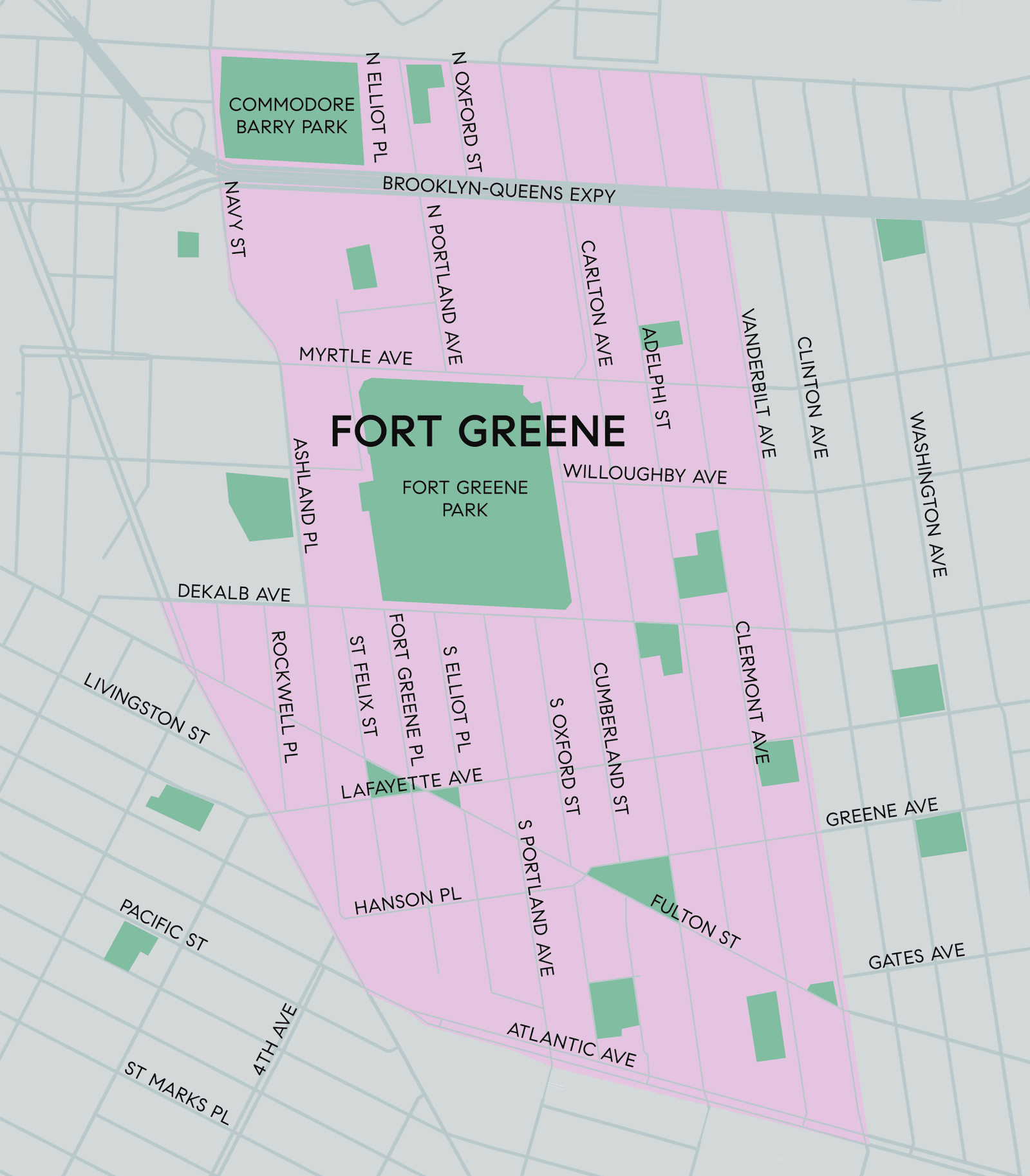
Fort Greene sits in northwest Brooklyn, bounded loosely by Flatbush Avenue to the west, the Brooklyn–Queens Expressway and Wallabout to the north, Vanderbilt Avenue to the east, and Atlantic Avenue to the south. The neighborhood takes its name from a Revolutionary War fortification on the high ground that is now Fort Greene Park — a 30-acre landscape designed in 1867 by Frederick Law Olmsted and Calvert Vaux, the same partnership behind Central Park and Prospect Park. Most of the housing stock around the park went up in a single tight window, roughly 1855 to 1875, when Brooklyn was an independent city and this was one of its most fashionable residential districts.
The Fort Greene Historic District, designated by the NYC Landmarks Preservation Commission in 1978, protects roughly 700 buildings — one of the most cohesive collections of 19th-century row houses in the country. The blocks radiating off the park (Lafayette Avenue, Cumberland Street, South Oxford Street, South Portland Avenue, Washington Park, Carlton Avenue) read as a near-continuous wall of Italianate, Greek Revival, Neo-Grec, Second Empire, and Queen Anne brownstone and brick, shaded by mature London plane trees.
South and west of the row-house core, the neighborhood changes character. The Brooklyn Academy of Music (BAM), founded in 1861, anchors the Brooklyn Cultural District, joined over the years by the Mark Morris Dance Center, BRIC, and MoCADA. Past that, toward Flatbush and Atlantic, sit the new-construction condo towers around Atlantic Terminal and Barclays Center. The buyer Fort Greene draws is specific: people who want a landmarked brownstone or a pre-war apartment near the park, value the cultural density, and accept that the protected blocks trade tightly and rarely.
Where Fort Greene trades in 2026.
Data caveats worth knowing. Fort Greene’s monthly medians swing hard because the trading pool is small — PropertyShark logged only seven recorded sales in April 2026. That is why the headline “−42% year-over-year” is a mix-and-sample artifact, not a market collapse: the April figure leans toward condos and co-ops, while Redfin’s trailing-three-month median (~$1.5M) captures a wider mix that includes the brownstones and townhouses which rarely close in any single month. The price-per-square-foot figure (about $1,138, roughly flat to slightly up) is the more reliable indicator. Restored single-family brownstones on the prime park blocks routinely clear $3M and up; the recorded medians do not reflect that tier because so few trade publicly. Read recent comparables on the same block and in the same building type, not the neighborhood average.
What’s actually for sale.
The defining inventory. Single-family and 2–4-family Italianate, Greek Revival, Neo-Grec, Second Empire, and Queen Anne row houses built 1855–1875, most inside the Historic District. Concentrated on the blocks off Fort Greene Park — Lafayette, Cumberland, South Oxford, South Portland, Washington Park, Carlton, and Adelphi. Restored single-family configurations command the strongest pricing; many buildings are still configured as two-to-four-unit rentals or owner-plus-rental.
Pre-war conversions in the larger apartment buildings, particularly along DeKalb, Fulton, and the avenues closer to BAM. Board approval and board packages apply; more conservative underwriting and stricter financials than the condo side.
A mix of pre-war condo conversions in the row-house belt and ground-up new construction concentrated toward Flatbush and Atlantic, near BAM, Atlantic Terminal, and Barclays. The new towers carry full amenity packages and trade on a different per-foot basis than the landmarked blocks.
The trophy tier of the brownstone stock — fully restored single-family houses on the park blocks. Rare on the open market; when one trades it often moves through a brokered conversation rather than a long public listing, and it can clear well above the recorded neighborhood medians.
What it’s like to live here.
Fort Greene Park.
The 30-acre Olmsted and Vaux park is the organizing center of the neighborhood — the high ground, the weekend greenmarket, the playgrounds, and the Prison Ship Martyrs’ Monument at the summit. Almost every desirable residential block reads off its perimeter. Proximity to the park, and the quality of the row-house wall facing it, drives a meaningful share of value.
BAM & the Brooklyn Cultural District.
The Brooklyn Academy of Music (founded 1861) anchors the southwest edge — opera, dance, the Next Wave Festival, and the BAM Rose Cinemas. Around it sit the Mark Morris Dance Center, BRIC Arts Media House, MoCADA, and the Theatre for a New Audience. This cultural density is a defining reason buyers choose Fort Greene over comparably priced Brooklyn blocks.
Dining & commercial strips.
DeKalb Avenue and Myrtle Avenue carry most of the restaurants, cafés, and neighborhood retail; Lafayette and Fulton add to the mix. The strips run residential-scale rather than tourist-scale, with a long-standing independent restaurant and bar culture. The weekly Fort Greene Park greenmarket is a fixture.
Transit.
Dense subway access on the south and west edges, plus the regional hub at Atlantic Terminal.
- DeKalb Avenue — B Q R
- Lafayette Avenue — C
- Fulton Street — G
- Atlantic Avenue–Barclays Center — B D N Q R and 2 3 4 5 (plus LIRR)
- Clinton–Washington Avenues — C (eastern edge)
Schools.
Fort Greene is in NYC Geographic District 13. Zoned elementary options nearby include PS 20 The Clinton Hill School (225 Adelphi Street, Pre-K–5) and PS 11 Purvis J. Behan (419 Waverly Avenue, Pre-K–5). Brooklyn Technical High School — one of the city’s specialized exam high schools — occupies a full block at 29 Fort Greene Place. Confirm current zoning lines with the DOE before relying on a specific elementary zone, as District 13 boundaries are revised periodically.
Built 1855 to 1875. Landmarked 1978.
The Fort Greene Historic District protects roughly 700 buildings — Italianate, Greek Revival, Neo-Grec, Second Empire, and Queen Anne brownstone and brick row houses, almost all built in a twenty-year window when Brooklyn was its own city. What you see on the park blocks is one of the most intact 19th-century residential streetscapes in the United States, and the landmark designation is the reason it has stayed that way.
Practical notes for buyers
- Inside the Historic District, exterior changes — facades, stoops, cornices, windows, ironwork — require NYC Landmarks Preservation Commission approval. It protects value and it extends renovation timelines; budget for the LPC process and for matching original materials.
- Many row houses are configured as 2–4-family buildings. Confirm the certificate of occupancy and the legal number of units before underwriting a single-family renovation or a rental-income assumption.
- Brownstone facades are maintenance items. Ask for the condition and repair history of the brownstone or brick face, the roof, and any rear-extension or party-wall work — these are the line items that move a renovation budget.
- For co-ops and condo conversions, ask for three years of board minutes and the assessment/reserve history; pre-war buildings near BAM carry their own capital-project calendars.
A block-by-block, building-by-building market.
Fort Greene is one of the Brooklyn markets Tracie has worked since she started in NYC real estate in 1995. Her practice in the neighborhood spans the range of property the area offers — landmarked single-family and multi-family brownstones on the park blocks, pre-war co-ops and condo conversions near BAM and DeKalb, and the newer condo product toward Atlantic and Flatbush.
“Two brownstones on the same block can price thirty percent apart on condition, configuration, and how much of the original detail survives. The neighborhood median — pulled from a handful of sales a month — is the worst possible number to set a price with.”
If you’re thinking about buying or selling in Fort Greene, the right starting move is a conversation about your specific building, your block, and your timing — not a generic walk-through.

Adjacent neighborhoods.
Fort Greene, in plain answers.
What is the average home price in Fort Greene?
It depends heavily on which source and property type you look at, because Fort Greene trades on a small number of sales each month. PropertyShark recorded an April 2026 median sale price of $775,000 (down 42.1% year-over-year on just seven sales), with a median price per square foot of about $1,138 (up roughly 3.3%). Redfin’s trailing-three-month figure ending March 2026 was closer to $1.5M, down about 8.8% year-over-year, because it captures a wider mix including brownstones. The dramatic year-over-year swing is a small-sample artifact. Restored single-family brownstones on the prime park blocks routinely clear $3M and up, well above the recorded medians — look at recent comparables on the same block and in the same building type, not the neighborhood average.
Is Fort Greene a good neighborhood to live in?
Fort Greene is one of Brooklyn’s most established brownstone neighborhoods, organized around the 30-acre Fort Greene Park (designed by Olmsted and Vaux), with the Brooklyn Academy of Music and the Brooklyn Cultural District on its southwest edge, dense subway access, and the regional transit hub at Atlantic Terminal a few blocks away. It draws buyers who value landmarked 19th-century architecture, proximity to culture, and a residential-scale rhythm close to Downtown Brooklyn and Manhattan.
What are the best streets in Fort Greene?
The most sought-after residential blocks tend to be those framing Fort Greene Park inside the Historic District — Washington Park, South Oxford Street, South Portland Avenue, Cumberland Street, Carlton Avenue, and Lafayette Avenue near the park. These hold the most intact runs of Italianate, Neo-Grec, and Second Empire row houses. Restored single-family houses on these blocks are tightly held and trade infrequently.
How are the schools in Fort Greene?
Fort Greene is in NYC Geographic District 13. Nearby zoned elementary options include PS 20 The Clinton Hill School (225 Adelphi Street, Pre-K–5) and PS 11 Purvis J. Behan (419 Waverly Avenue, Pre-K–5). Brooklyn Technical High School — one of New York City’s specialized exam high schools — is located in the neighborhood at 29 Fort Greene Place. Because District 13 zoning lines are revised periodically, confirm the current elementary zone for a specific address with the NYC Department of Education.
What subway lines serve Fort Greene?
Fort Greene is served by the B, Q, R at DeKalb Avenue; the C at Lafayette Avenue and at Clinton–Washington Avenues; and the G at Fulton Street. The Atlantic Avenue–Barclays Center complex at the southern edge adds the B, D, N, Q, R and the 2, 3, 4, 5, plus the Long Island Rail Road at Atlantic Terminal — one of the densest transit hubs in Brooklyn.
Is Fort Greene a historic district?
Yes. The Fort Greene Historic District was designated by the NYC Landmarks Preservation Commission in 1978 and protects roughly 700 buildings — primarily Italianate, Greek Revival, Neo-Grec, Second Empire, and Queen Anne row houses built between about 1855 and 1875. Exterior changes to buildings within the district — facades, stoops, cornices, windows, ironwork — require LPC approval, which protects the streetscape’s value but can extend renovation timelines.
What’s the difference between a Fort Greene brownstone and a condo?
A Fort Greene brownstone is a 19th-century row house, often inside the Historic District and frequently configured as a single-family or 2–4-family building; it trades on condition, configuration, surviving original detail, and proximity to Fort Greene Park, and exterior work is governed by the Landmarks Preservation Commission. A Fort Greene condo is more often a pre-war conversion or a newer-construction apartment toward Flatbush and Atlantic near BAM and Barclays, with a more conventional apartment layout, amenity packages, and easier financing than a co-op. Co-ops, the third option, add board approval and a board package to the process.
Let’s talk about your building.
Tracie Golding — Compass · New York, NY. Selling Manhattan and Brooklyn since 1995.
Schedule a consultation