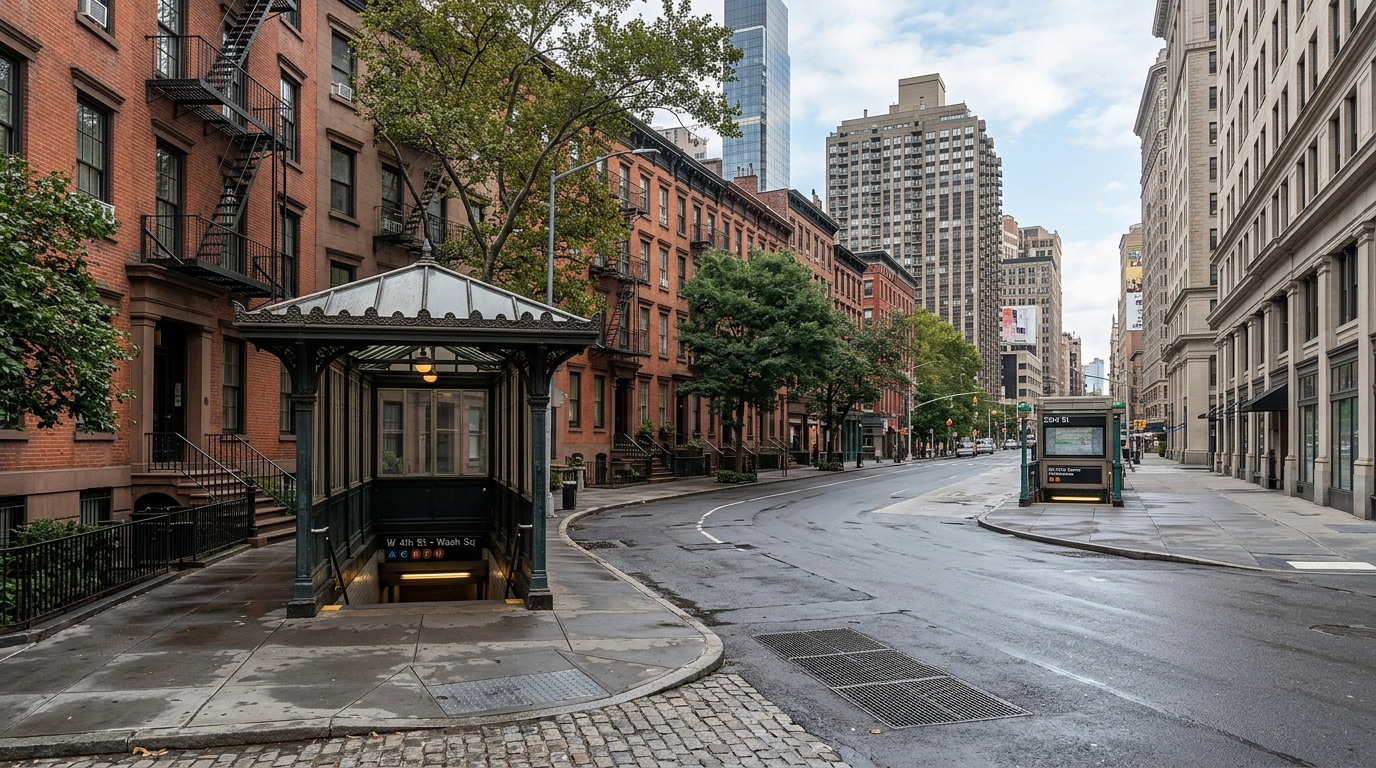
What should I know about commute and access tradeoffs between Greenwich Village and Flatiron?
The single biggest difference is where the fast trains live. Greenwich Village has a true express hub inside the neighborhood at West 4th Street…
The single biggest difference is where the fast trains live. Flatiron has no interior express station. That 14th Street corridor is the shared southern edge of both neighborhoods, so for the northern reach of Flatiron near 23rd Street, effective access depends heavily on how close a specific address sits to Union Square. Both neighborhoods reach New Jersey by PATH and both have at least one ADA-accessible core station, but the accessibility picture changes line by line. The right choice comes down to which trips you make most and where within each neighborhood you actually land.
Greenwich Village spreads its transit across several trunk lines, while Flatiron concentrates most of its service into one cluster around 23rd Street. That distinction shapes how flexible your daily commute feels.
Greenwich Village, bounded by 14th Street to the north, Broadway to the east, Houston Street to the south, and the Hudson River to the west, pulls from three separate systems.
Which neighborhood offers more subway line variety, and where is it concentrated?
The IND lines converge at West 4th Street, Washington Square. West-side, cross-town, and east-of-Broadway trips all have a natural on-ramp.
Flatiron, framed by 14th Street to the south and 23rd Street to the north, leans on a tighter cluster. The Sixth Avenue F and M stop, the Broadway N/Q/R/W stop, and the Lexington-side 6 stop all sit along the 23rd Street band. That gives Flatiron something Greenwich Village's interior does not have as directly: an in-district Lexington Avenue (6) station at Park Avenue South and 23rd Street, served by the 6 at all times, the peak-direction express during weekdays, and the 4 during late nights. If your work sits along the East Side Lexington corridor, that in-district 6 access is a genuine Flatiron advantage.
For a deeper look at each area on its own terms, the Greenwich Village neighborhood guide and the Flatiron neighborhood guide break down the streets and blocks in more detail.
Does Greenwich Village or Flatiron have better in-neighborhood express service?
Greenwich Village has in-neighborhood express service; Flatiron does not. An express station is one where faster trains skip local stops, cutting the number of stations between you and Midtown or Lower Manhattan.
Flatiron's picture is different. For a Flatiron resident who wants an express, the practical move is walking south to Union Square or north to 34th Street. That is the core commute tradeoff: Greenwich Village bakes express access into the neighborhood, while Flatiron asks you to walk to it.
| Dimension | Greenwich Village | Flatiron District |
|---|---|---|
| Interior express hub | West 4th St, Washington Square (A/C/E, B/D/F/M) | None; 23rd St stations are local |
| Core station 2024 ridership | 10,872,225 (rank 18/423) | 5,958,666 at 23rd St/6th Ave (rank 42/423) |
| In-district Lexington (6) access | Reached via neighborhood edge | Direct at Park Ave South & 23rd St |
How does the shared 14th Street / Union Square corridor change the math?
The 14th Street / Union Square hub is a shared access asset for both neighborhoods, and proximity to it decides who actually benefits. It sits at 14th Street, which is the northern boundary of Greenwich Village and the southern boundary of Flatiron. Both neighborhoods touch this edge, but neither owns it outright.
Union Square is one of the busiest stations in the system. It carried 22,811,597 riders in 2024, ranking 4th of 423 stations, and is served by the 4, 6, L, N, and Q at all times, the 5 and R at all times except late nights, and the W on weekdays. (14th Street%E2%80%93Union Square station) That L train connection is the fast east-west link across 14th Street, and the 4/5 give express Lexington service that neither neighborhood's interior local stops provide on their own.
Here is where address specificity matters most. A Flatiron apartment near the southern edge, closer to 14th Street, effectively inherits Union Square access. A Flatiron apartment near 23rd Street is meaningfully further from that hub and is better judged by its local 23rd Street stops. Buyers should not assume any Flatiron address enjoys Union Square speed, or dismiss Flatiron entirely by looking only at the local stations. Before committing, walk the actual route from the specific unit to Union Square at the time of day you would commute. The block count, not the neighborhood name, is what determines your real morning.
Do both Greenwich Village and Flatiron offer PATH access to New Jersey?
Yes. Both neighborhoods have PATH access to New Jersey, which is the regional rail line connecting Manhattan to Hoboken, Jersey City, and Newark. This matters if you or a household member commutes across the Hudson.
For a Flatiron resident on the western side near Sixth Avenue, that 23rd Street PATH stop is often the closest New Jersey link. So neither neighborhood forces a long trek to reach the Hudson crossing; the deciding factor is which side of the neighborhood your home sits on and which PATH terminal your New Jersey destination favors.
Which subway stations in each neighborhood are ADA-accessible?
Both Greenwich Village and Flatiron have at least one ADA-accessible core station, but accessibility is decided station by station and line by line, not by neighborhood. ADA accessibility means the station has elevators or ramps meeting federal standards, so it is a hard constraint worth confirming for any mobility-limited commuter.
The shared Union Square hub is a caution. If a step-free trip on a specific line matters, confirm the exact platform, because being able to reach the station is not the same as being able to reach your train. Check the MTA's accessibility listing for the precise station and line before you sign anything, and factor the walk to the nearest accessible entrance into your address decision.
If you want help matching a specific address to the trips you actually make, the neighborhood fit consultation is built for exactly that comparison, and you can also weigh how Flatiron compares to NoMad just to the north.
Let’s talk about your block, building, apartment
The right starting move is a conversation with the right broker.
The Right Broker Makes All The Difference