Chelsea
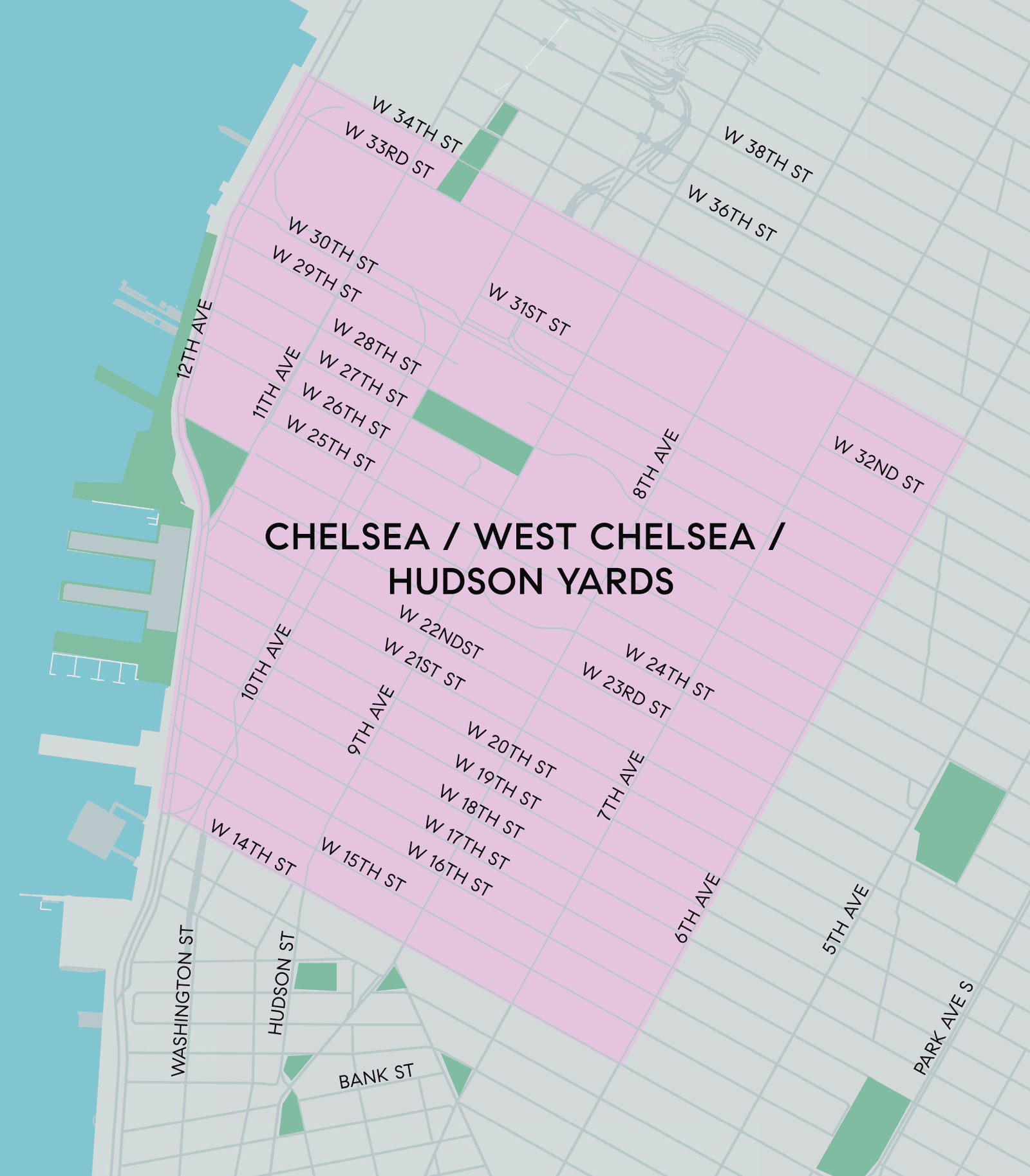
The broader Chelsea district from 14th Street to the low 30s, Sixth Avenue to the Hudson — a layered market of pre-war co-ops, Greek Revival and Italianate row houses inside the Chelsea Historic District, condos, and postwar blocks. Not to be confused with West Chelsea, the High Line corridor west of Tenth.
Clement Clarke Moore’s estate, sold block by block.
Chelsea runs roughly from West 14th Street north to the low 30s, and from Sixth Avenue west to the Hudson River. It should not be confused with West Chelsea — the narrower High Line and gallery corridor west of Tenth Avenue, where architect-led new construction trades at a meaningfully higher per-foot. The Chelsea covered here is the wider neighborhood, and at its center sits the Chelsea Historic District, the row-house core around Cushman Row on West 20th Street.
The land was the country estate of Clement Clarke Moore, who laid out the street grid and began selling lots in the 1830s. The Greek Revival and Italianate row houses that define the Historic District went up largely in the two decades before the Civil War; the General Theological Seminary (campus established 1827, Gothic Revival buildings from the 1830s) and St. Peter’s Church (consecrated 1832) anchor the center. The NYC Landmarks Preservation Commission designated the Chelsea Historic District in 1970, with an extension in 1981.
Today Chelsea holds one of Manhattan’s most mixed housing stocks: pre-war co-ops, Greek Revival and Italianate row houses inside the Historic District, ground-up and converted condos, postwar apartment blocks, the London Terrace complex (opened 1930, one of the largest apartment blocks in the world at the time), the Penn South limited-equity cooperative (1962), and two NYCHA developments. The result is a market that does not have a single price — it has several, layered block by block.
Where Chelsea trades in 2026.
Data caveats worth knowing. Chelsea’s monthly medians are noisy because the recorded-sale pool is small and the housing stock is unusually wide — a sub-$600K Penn South or co-op resale and a multi-million-dollar condo can close in the same month. PropertyShark’s April 2026 figures show a $1.7M overall median (up sharply year-over-year) sitting beside a co-op median that swung roughly +286% YoY, which is mix-shift, not real appreciation. DecodeNYC’s Q1 2026 read on the condo segment is steadier: a median condo value around $2.2M, roughly 10% below 2024 peaks, with closings down about 13% YoY and days-on-market near 90–110. Treat these as conservative ranges, not point estimates, and price against same-building and same-block comparables.
What’s actually for sale.
The defining low-rise stock — Greek Revival and Italianate townhouses from roughly 1839 to the 1860s, concentrated on West 20th, 21st, and 22nd Streets between Eighth and Tenth Avenues. Cushman Row (406–418 West 20th, 1839–40) is the canonical block. These rarely trade and almost never quickly; exterior changes require LPC approval.
The largest ownership category across much of the district. Includes the Penn South limited-equity cooperative (1962, income-restricted resale) and a range of pre-war elevator co-op buildings with board packages and stricter approval and more conservative buyers.
Both converted pre-war buildings and newer ground-up construction, generally east of Tenth Avenue — distinct from the West Chelsea trophy towers. Full amenity packages and more straightforward financing rules than the co-ops.
Mid-century apartment buildings plus London Terrace (1930) — a full-block complex of roughly 1,600+ units straddling West 23rd and 24th, split between a co-op (London Terrace Towers) and a rental (London Terrace Gardens).
What it’s like to live here.
The street pattern.
The Historic District blocks (West 20th–22nd between Eighth and Tenth) are tree-lined, low-scale, and quiet — among the most intact pre-Civil-War streetscapes in Manhattan. North and east, the scale rises into apartment blocks and commercial frontage along Sixth, Seventh, and Eighth Avenues.
Food & retail.
Chelsea Market — the former Nabisco complex on Ninth Avenue between 15th and 16th — is the anchor food hall. Eighth Avenue is the neighborhood’s restaurant-and-bar spine, and the Flower District edge sits to the northeast around West 28th Street.
Parks & culture.
The General Theological Seminary’s Close, Clement Clarke Moore Park, and Chelsea Waterside Park along the Hudson. The High Line and the densest contemporary-art gallery cluster in the world sit just west in West Chelsea, a short walk from most Chelsea addresses.
Transit.
Three avenue trunk lines cross the district, with 23rd Street and 14th Street the principal nodes. Walk Score sits around 98.
- 23rd Street — C E (Eighth Ave), 1 (Seventh Ave), F M (Sixth Ave)
- 14th Street / Eighth Ave — A C E plus L crosstown
- 34th Street–Hudson Yards — 7 (western edge)
- Crosstown buses M14 and M23; dense Citi Bike coverage
Schools.
Chelsea is in Community School District 2. The zoned public elementaries are P.S. 11 William T. Harris (320 West 21st Street, K–5) and P.S. 33 Chelsea Prep (281 Ninth Avenue, K–5). Chelsea Career and Technical Education High School also serves the area, alongside private and District 2 choice options.
- P.S. 11 William T. Harris — 320 West 21st Street, K–5, District 2
- P.S. 33 Chelsea Prep — 281 Ninth Avenue, K–5, District 2
- Chelsea Career and Technical Education High School
Greek Revival and Italianate. Designated 1970.
The Chelsea Historic District (designated 1970, extended 1981; National Register 1977/1982) protects the Greek Revival and Italianate row-house core developed on Clement Clarke Moore’s estate. Cushman Row and the surrounding West 20th–22nd Street blocks are the best-preserved examples; the General Theological Seminary and St. Peter’s Church anchor the center. Outside the district, the stock shifts to pre-war and postwar apartment buildings, London Terrace, Penn South, and newer condo construction.
Practical notes for buyers
- Inside the Historic District, exterior changes — windows, stoops, cornices, storefronts — require LPC approval. It protects value but lengthens renovation timelines. Verify the certificate of occupancy and any open LPC permits.
- Penn South is a limited-equity co-op with income caps and a regulated resale formula — it is not a market-rate purchase. Confirm eligibility before pursuing a unit there.
- Pre-war co-ops carry board packages and approval; budget for the timeline and review three years of board minutes plus the reserve and assessment history.
- London Terrace is split between a co-op (Towers) and a rental (Gardens) — confirm which side a given unit sits in.
- Chelsea pricing east of Tenth Avenue runs well below the West Chelsea High Line trophy buildings; do not benchmark the two against each other.
Three markets sharing one ZIP code.
Chelsea is one of the Manhattan markets Tracie has worked since she started in NYC real estate in 1995. Her practice here spans the range the district actually offers — Historic District row houses on the West 20s, pre-war co-op apartments, condo resales, and the London Terrace and postwar blocks — which is exactly why a single neighborhood median is so misleading.
“Chelsea isn’t one market — it’s a co-op market, a row-house market, and a condo market sharing the same ZIP code. The monthly median tells you almost nothing until you separate them. Price against the same building and the same block, never the headline number.”
If you’re thinking about buying or selling in Chelsea, the right starting move is a conversation about your specific building, your block, and your timing — not a generic walk-through.

Adjacent neighborhoods.
Chelsea, in plain answers.
What is the average home price in Chelsea?
PropertyShark recorded an April 2026 median sale price of about $1.7M across all property types in Chelsea, with a median of roughly $1,735 per square foot. The condo segment trends higher — around $2.2–2.3M — while co-op medians run far lower (PropertyShark showed $580K–$887K in recent months, on a small and volatile sample). Because the housing stock is so mixed, the all-in median moves with the month’s mix of sales; price against same-building and same-block comparables.
How is Chelsea different from West Chelsea?
West Chelsea is the narrower corridor west of Tenth Avenue, defined by the High Line and the gallery district, with architect-led new construction trading at a meaningfully higher per-foot. The broader Chelsea runs from Sixth Avenue west and is a mix of pre-war co-ops, Historic District row houses, condos, and postwar buildings — a much wider and generally lower per-foot range.
Is Chelsea a historic district?
Yes. The NYC Landmarks Preservation Commission designated the Chelsea Historic District in 1970 and added an extension in 1981 (National Register 1977, expanded 1982). It protects the Greek Revival and Italianate row-house core around Cushman Row (West 20th–22nd Streets), the General Theological Seminary, and St. Peter’s Church. Exterior changes to landmarked buildings require LPC approval.
What subway lines serve Chelsea?
Three avenue trunk lines cross the district. The C and E run under Eighth Avenue (23rd St, 14th St); the 1 runs under Seventh Avenue (23rd St, 18th St); the F and M run under Sixth Avenue (23rd St, 14th St). The A and C and the L crosstown serve 14th Street–Eighth Avenue, and the 7 reaches the western edge at 34th Street–Hudson Yards. Walk Score is around 98.
How are the schools in Chelsea?
Chelsea is in Community School District 2. The zoned public elementaries are P.S. 11 William T. Harris (320 West 21st Street, K–5) and P.S. 33 Chelsea Prep (281 Ninth Avenue, K–5). Chelsea Career and Technical Education High School also serves the area, alongside private and District 2 choice options.
What is Penn South?
Penn South (Mutual Redevelopment Houses, 1962) is a limited-equity cooperative in northern Chelsea with income restrictions and a regulated resale formula. It is not a market-rate purchase — confirm eligibility before pursuing a unit there.
What are the best streets in Chelsea?
The most desirable residential blocks are inside the Historic District — West 20th, 21st, and 22nd Streets between Eighth and Tenth Avenues, including Cushman Row (406–418 West 20th). These tree-lined row-house blocks are tightly held and rarely come to market.
Let’s talk about your building.
Tracie Golding — Compass · New York, NY. Selling Manhattan and Brooklyn since 1995.
Schedule a consultation