NoMad
North of Madison Square Park — a landmarked commercial-loft district turned residential, where the stock splits between office-and-loft condo conversions and a handful of new luxury towers, and the per-foot gap between the two is wide.
A commercial district that turned residential.
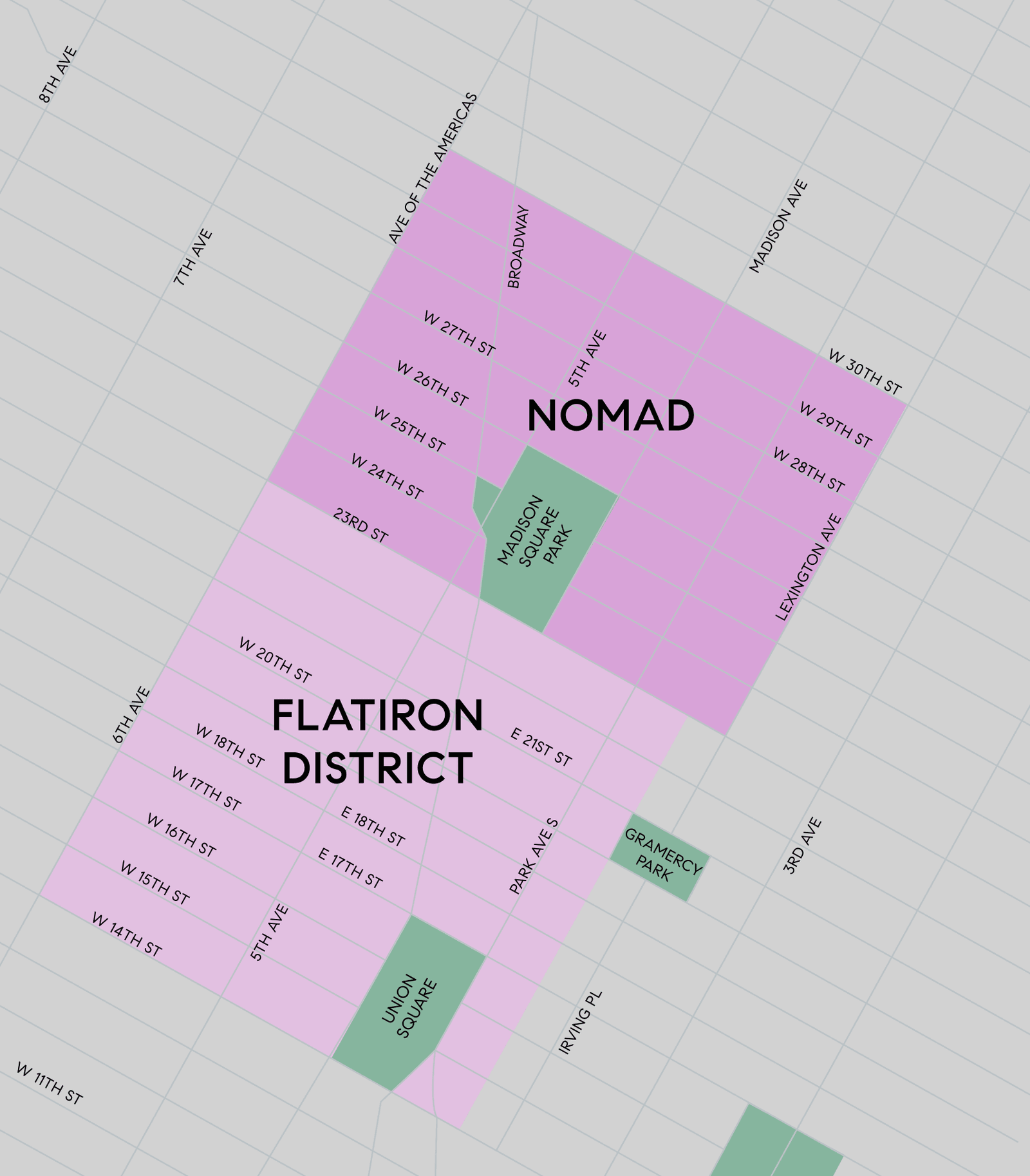
NoMad — “North of Madison” — sits directly north of Madison Square Park, generally bounded by East 25th Street to the south, East 29th–30th Street to the north, Sixth Avenue to the west, and Madison and Lexington Avenue to the east. Like every Manhattan neighborhood, the edges are drawn by common usage rather than by statute, and sources disagree by a block or two. It falls inside Manhattan Community District 5.
The name itself is recent — it gained traction around 1999; the NYC Landmarks Preservation Commission designated the Madison Square North Historic District in 2001. The district protects the dense run of late-19th and early-20th-century commercial loft, hotel, and store-and-loft buildings at the neighborhood’s core. For most of the 20th century this was a wholesale and office district; the residential NoMad is a newer layer laid over that older commercial fabric.
What changed it was Madison Square Park’s 2001 restoration and the hotel-driven revival that followed — the NoMad Hotel opening at Broadway and 28th Street in 2012 is the usual marker. The buyer NoMad draws today is choosing between two very different things on the same few blocks: a converted loft floor in a landmarked building, or a unit in a new ground-up tower with a full amenity package. They price differently, and the neighborhood average tells you little about either.
Where NoMad trades in 2026.
Data caveats worth knowing. NoMad is a small, statistically noisy submarket. PropertyShark’s April 2026 median ($1.5M) and Redfin’s October 2025 figure (~$2.4M) differ sharply because both are computed on roughly a dozen-and-a-half closings a month across a very wide unit range — one new-tower full-floor trade swings the monthly number. CityRealty’s building-weighted per-foot condo index (~$2,002/sq ft, −8.5% over the trailing twelve months, projected roughly flat for 2026) is the steadier read. Treat any single median as directional, not precise: high-$1M to low-$2M for a typical home, condos clustering ~$1,650–$2,000 a foot, with new-tower trophy floors well above that.
What’s actually for sale.
The backbone of the residential stock. Former office and commercial-loft buildings carved into residences after the park’s 2001 restoration — high ceilings, large floorplates, and amenity packages that range from minimal to full. Pricing turns on the building and the floor, not the block.
Ground-up towers near Madison Square Park, including the Madison Square Park tower cluster, with full amenity packages and the highest per-foot pricing in the neighborhood. These set the trophy end of the market and pull the monthly median around when one trades.
A minority of the stock. Pre-war conversions that took the co-op route instead of condo, with board-package review and more conservative financing. Fewer of them come up than the condo inventory.
A meaningful share of the district is still hospitality and commercial — the NoMad Hotel, the historic Fifth Avenue Hotel, and Fifth Avenue / Broadway retail. It shapes the streetscape and means residential blocks sit alongside hotel and office frontage.
What it’s like to live here.
Madison Square Park.
The park is NoMad’s front yard — the original Shake Shack kiosk, rotating public art on the lawn, and the Flatiron Building at the south point. The 2001 restoration is what turned the surrounding blocks residential, and the park remains the anchor for daily life on the south edge.
Dining & hotels.
The neighborhood’s identity was rebuilt around hotels and restaurants. The NoMad Hotel at Broadway and 28th Street (2012) is the usual marker of the revival; the Fifth Avenue Hotel traces back to 1859. Eataly sits at the Flatiron edge, and the Broadway / Fifth Avenue corridor carries the bulk of the dining and retail.
Retail spine.
Fifth Avenue and Broadway run the length of the neighborhood and carry most of the ground-floor retail and foot traffic. Side streets in the Historic District core are quieter and more residential despite the commercial zoning around them.
Transit.
Two subway lines through the middle, a third along the southern edge, PATH at 23rd Street, and Herald Square a short walk north.
- 28th Street — R W (BMT Broadway Line)
- 28th Street — 6 (IRT Lexington Avenue Line)
- 23rd Street — R W and 6 (southern edge)
- 23rd Street–Sixth Ave — F M, plus PATH to Hoboken & Jersey City
- 34th St–Herald Square (north walk) — B D F M N Q R W
Schools.
NoMad is zoned to NYC Community School District 2. Zoning is by address, and District 2 boundaries shift, so families should confirm the current zoned elementary with the DOE school-finder for a specific building. The neighborhood has limited zoned-school stock of its own and leans on the broader District 2 public network and the area’s private options.
Built 1870 to 1910. Landmarked 2001.
The Madison Square North Historic District, designated by the NYC Landmarks Preservation Commission in 2001, protects the dense run of late-19th and early-20th-century commercial loft, hotel, and store-and-loft buildings at NoMad’s core. The styles on the street are Second Empire, Beaux-Arts, French Renaissance Revival, and Baroque. Landmarks include the New York Life Building, the Gilsey House (1869–71), the Johnston Building (now the NoMad Hotel), and the Fifth Avenue Hotel — completed in 1859 and, at the time, the first American hotel with an elevator and private bathrooms.
Practical notes for buyers
- Most residences here are conversions — confirm the certificate of occupancy and whether the building is fully residential or still mixed commercial/hospitality.
- Inside the Historic District, exterior changes — windows, storefronts, signage, cornices — route through the Landmarks Preservation Commission. It protects value and extends renovation timelines.
- Conversion buildings carry capital-reserve and facade-assessment histories. Ask for three years of board minutes before you commit.
- New towers price well above the conversion stock per foot — the gap between a trophy tower floor and an older converted-loft unit two blocks away can run more than a thousand dollars a foot.
Price the building, not the neighborhood.
NoMad is a market Tracie has watched evolve since she started in NYC real estate in 1995 — from a wholesale-and-office district into a residential one layered onto landmarked bones. Her read of the area is that the single most common buyer mistake is anchoring to a neighborhood median, when the real spread is between a new amenity tower and a converted loft floor on the same block.
“A new-tower floor and a converted-loft floor can sit on the same block and trade more than a thousand dollars a foot apart. In NoMad you price the building, not the neighborhood.”
If you’re thinking about buying or selling in NoMad, the right starting move is a conversation about your specific building, your block, and your timing — not a generic walk-through.

Adjacent neighborhoods.
NoMad, in plain answers.
What is the average home price in NoMad?
NoMad medians swing because the submarket is small. PropertyShark recorded an April 2026 median home sale price of about $1.5M (down ~4.8% year-over-year) at roughly $1,644 per square foot, with a condo median near $1.7M. Redfin showed a higher October 2025 median around $2.4M (~$1,856/sq ft), and CityRealty’s building-weighted condo index runs around $2,002 per square foot (down ~8.5% over the trailing twelve months). With roughly 17 trades a month, a single new-tower sale moves the median — look at recent comparables in the same building, not the neighborhood average.
Where are NoMad’s boundaries?
NoMad — North of Madison Square Park — runs roughly from East 25th Street on the south to East 29th–30th Street on the north, with Sixth Avenue to the west and Madison/Lexington Avenue to the east. It sits in Manhattan Community District 5. As with all NYC neighborhoods, the lines are set by common usage rather than by the city, so sources disagree by a block or two.
Is NoMad a historic district?
The core of NoMad falls inside the Madison Square North Historic District, designated by the NYC Landmarks Preservation Commission in 2001. It protects late-19th and early-20th-century commercial loft, hotel, and store-and-loft buildings in Second Empire, Beaux-Arts, French Renaissance Revival, and Baroque styles. Exterior changes to landmarked buildings require LPC approval.
What subway lines serve NoMad?
NoMad is served by the R and W (BMT Broadway Line) at 28th Street and 23rd Street, and the 6 (IRT Lexington Avenue Line) at 28th Street and 23rd Street. The F and M and PATH (to Hoboken and Jersey City) are at 23rd Street–Sixth Avenue, and the 34th Street–Herald Square hub (B D F M N Q R W) is a short walk north. Numerous bus routes also run through the neighborhood.
What kind of apartments are in NoMad?
The residential stock is dominated by condos — both office- and loft-to-residential conversions in landmarked buildings and a wave of new ground-up luxury towers near Madison Square Park. There is a smaller share of pre-war co-ops, and a meaningful portion of the district is still hotels and commercial space. A converted loft floor and a new amenity-tower unit on the same block can trade more than a thousand dollars a foot apart.
How are the schools in NoMad?
NoMad is zoned to NYC Community School District 2, one of the city’s sought-after districts. Public-school zoning is by address and District 2 boundaries shift, so families should confirm the current zoned elementary for a specific building with the DOE school-finder. The neighborhood has limited zoned-school stock of its own and relies on the broader District 2 public network plus the area’s private options.
What’s the difference between a NoMad loft conversion and a new NoMad tower?
A NoMad loft conversion is a former office or commercial-loft building turned residential after 2001 — high ceilings, large floorplates, and amenity packages that range from minimal to full, inside a landmarked structure where exterior work routes through the LPC. A new NoMad tower is ground-up construction with a full amenity package and the highest per-foot pricing in the neighborhood. The two trade very differently, which is why the neighborhood median is a poor pricing guide.
Let’s talk about your building.
Tracie Golding — Compass · New York, NY. Selling Manhattan and Brooklyn since 1995.
Schedule a consultation